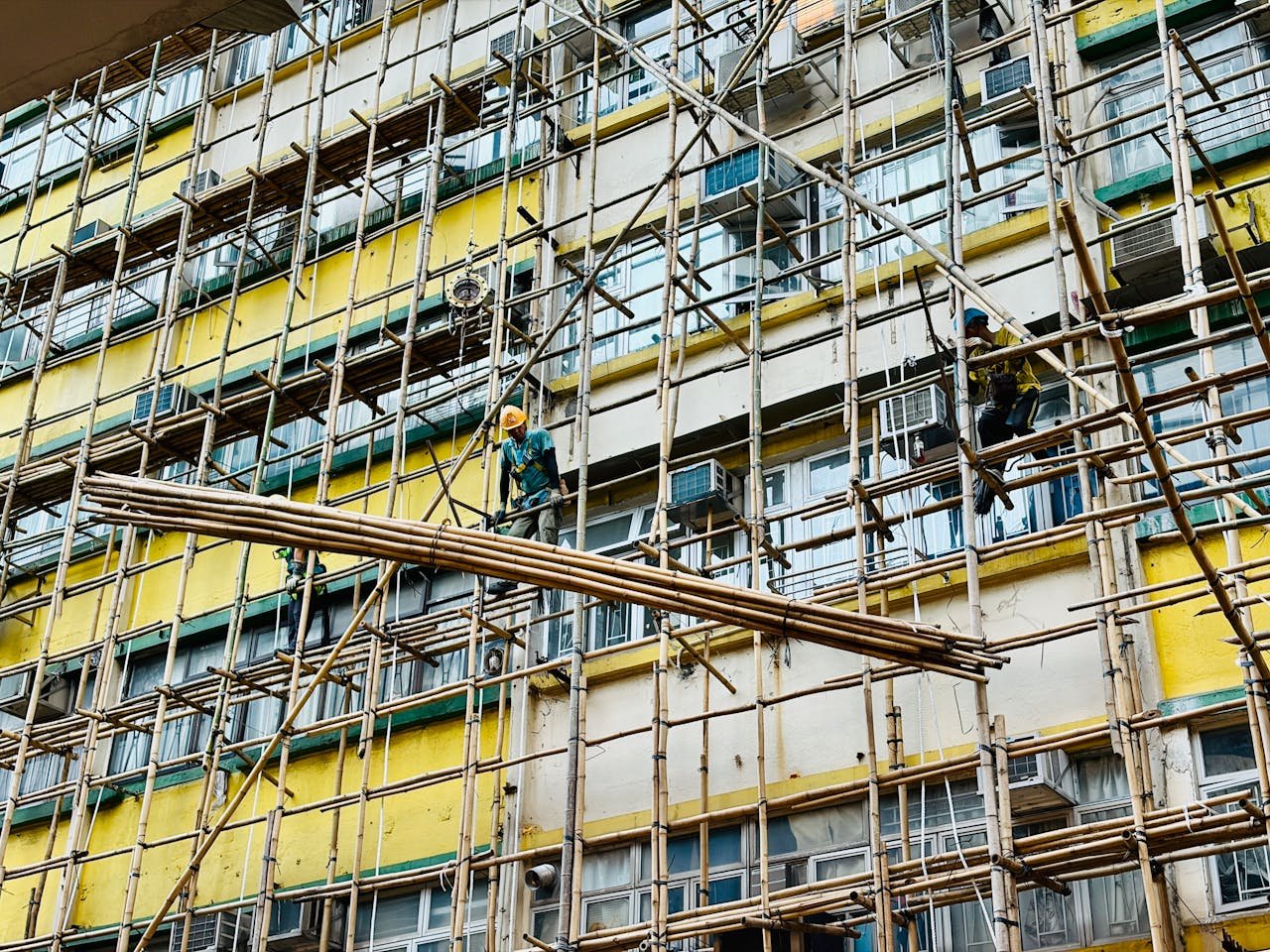
For most UK homes, repointing a chimney stack without some form of scaffolding is not legal, not insured, and not worth the risk. If your chimney sits above a two-storey roof, the answer is almost certainly no — and this guide explains exactly why.
The Direct Answer on Repointing a Chimney Without Scaffolding
Pointing a chimney without scaffold access at two-storey height is not simply inadvisable — it is non-compliant with UK law. The Working at Height Regulations 2005 require that any work above ground level with a risk of falls must be properly planned, with appropriate safe access equipment in place. A ladder leant against a chimney stack does not meet that standard.
That said, the answer is not a flat no in every case. For single-storey extensions, rear additions, or bungalow stacks that do not rise far above the roofline, a scaffold tower or mobile elevated work platform (MEWP) can sometimes provide adequate safe access. The key word is adequate — not absent.
The grey area exists at the lower end of the height scale. At two storeys and above, the position is clear: proper scaffolding is required.
What the Working at Height Regulations 2005 Say
The Working at Height Regulations 2005, enforced by the HSE, apply to any work carried out above ground where there is a risk of falling. Chimney repointing qualifies without question. The regulations place duties on employers and the self-employed alike — and homeowners who commission work on their own property carry responsibilities as the client under related construction legislation.
Under the regulations, whoever is responsible for the work must ensure that:
- Work at height is properly planned and organised before it starts
- Anyone carrying out the work is competent to do it safely
- Appropriate equipment is selected and correctly used
- Risks from fragile surfaces — roof tiles, deteriorating flashings — are managed
- All equipment is inspected and fit for purpose before use
The HSE's own guidance is clear that ladders are not a suitable working platform for sustained, physically demanding tasks such as chiselling out old mortar and applying new pointing. A ladder may get a person to roof level, but it cannot provide a stable platform for the work itself.
Contractors who plan to carry out chimney repointing from a ladder alone are not complying with these regulations. If you see this approach being proposed, treat it as a warning sign — not a convenience or a cost saving.
What Chimney Repair Without Scaffolding Does to Your Insurance
Home insurance and public liability cover typically depend on work being carried out in compliance with relevant legislation. If a contractor falls while doing chimney repair without scaffolding or equivalent safe access, your insurer may decline to meet any claim on the grounds that the work was not legally compliant.
If you carry out the work yourself without proper access and cause injury or damage — to a neighbour, a passer-by, or anyone on your property — you face the same exposure: a claim that may be disputed or denied.
There is a building insurance angle too. Work done from an inadequate position tends to be done poorly, and insurers can challenge subsequent claims for water ingress or structural damage if they establish that the repointing was substandard. On chimney stacks this matters — bad pointing allows water into the brickwork, which freezes in winter and causes spalling and structural deterioration, turning a small maintenance job into a significant repair.
Ask any contractor you are considering how they plan to access the chimney and confirm in writing that their method is compliant. A professional firm will answer without hesitation. To estimate your scaffolding cost for a chimney repointing job based on your property type and height, the calculator gives you an instant range drawn from real UK pricing data.
When a Scaffold Tower Might Be Enough
There is a category of chimney work where full tube-and-fitting or system scaffold is not strictly necessary — but only where a properly set-up scaffold tower or MEWP provides equivalent safe access in its place.
Lower Stacks and Single-Storey Properties
For a chimney on a single-storey extension, a rear addition, or a bungalow, a freestanding aluminium scaffold tower can be appropriate if:
- It is erected on firm, level ground — not on roof tiles or a sloped surface
- It reaches a comfortable working height so the operative does not need to overreach
- Outriggers or stabilisers are fitted as required by the manufacturer's instructions
- There is a proper internal access ladder and a full-width working platform with guardrails on all open sides
- The person erecting and using it is trained and competent — PASMA training is the industry-recognised standard
Scaffold tower hire is widely available from plant hire companies across the UK. A PASMA-trained contractor or a homeowner who has completed PASMA training can legally erect and use a tower, provided it is suitable for the specific task and height involved.
When a Tower Is Not the Right Solution
For a standard two-storey UK property — semi-detached, terrace, or detached — a freestanding scaffold tower is unlikely to be adequate for chimney access. The required working height, the roof pitch, and the need to work close to the stack without overreaching all point to the need for a proper scaffold erected against the building.
Gable-end chimney stacks often require scaffolding on two or three elevations. A scaffold tower cannot safely cover those configurations. If a contractor suggests using a tower on a full two-storey chimney, ask them to explain exactly how the working height and reach requirements will be met safely. In most cases, they cannot provide a satisfactory answer.
Cantilever Scaffolding, MEWPs, and Rope Access
Not all chimney jobs call for a full wrap-around scaffold. Several alternative access methods are used by specialist contractors, each with their own requirements and limitations:
- Cantilever scaffolding: Used where a ground-based scaffold is impractical — over a conservatory, a narrow access passage, or a ground-floor extension. Requires a qualified scaffolding contractor to design and erect. Not a DIY or ad-hoc solution.
- Cherry pickers and MEWPs: A mobile elevated work platform can provide safe access for chimney repair without scaffolding where the site allows vehicular access. Operators must be trained, and hire costs can be comparable to conventional scaffolding for smaller jobs.
- Rope access: Used occasionally by specialist contractors on particularly difficult or remote stacks. Requires specialist training, a full safety system, and a second person on site. Not appropriate for routine repointing jobs.
Each of these replaces the need for conventional scaffolding — none of them replaces the need for safe access. "No scaffolding" does not mean "no safety measures", and any contractor who frames it that way should give you pause.
What Scaffolding for Chimney Repointing Typically Costs
The cost of scaffolding depends on your property type, height, the number of elevations needed, and how long the scaffold is hired. Prices are higher in London and the South East and lower in northern England, Scotland, Wales, and Northern Ireland.
| Property type | Typical scaffolding cost range | Notes |
|---|---|---|
| Bungalow or single storey | £300–£600 | Tower may be sufficient; full scaffold sometimes needed |
| Two-storey terrace or semi-detached | £600–£1,200 | Standard chimney scaffold on one elevation |
| Two-storey detached, larger stack | £800–£1,500 | May require access on two or three elevations |
| Three-storey or tall gable-end chimney | £1,000–£2,000+ | Greater height and reach add significantly to cost |
Scaffold for a standard repointing job is typically hired for one to two weeks. If other chimney work needs doing at the same time — flaunching, leadwork, chimney pot replacement, or soffit repairs — it makes sense to keep the scaffold in place and tackle everything in a single visit. This spreads the access cost across multiple jobs and avoids a second mobilisation charge.
You can find more cost guides and advice for planned roof and chimney work on the ScaffSource blog.
Questions to Ask Before Work Starts
Before agreeing to any chimney repointing job, put these questions directly to the contractor:
- How will you access the chimney? Ask for a specific method, not a vague reassurance.
- Are you using scaffolding, a tower, or a MEWP? If none of these, ask what the alternative is and why it is compliant.
- Are you insured for working at height on chimney stacks? Ask to see the insurance certificate if needed.
- Is scaffolding included in your quote, or is it an additional charge? Some contractors price access separately.
- Who erects the scaffold — your firm or a sub-contractor? Clarify accountability before any work starts.
A competent, properly insured contractor will answer all of these without hesitation. If you are being told that scaffolding is unnecessary for a two-storey chimney, or that a ladder will do, find someone else.
The Real Cost of Getting It Wrong
Falls from height remain among the leading causes of serious injury and death in construction in the UK, based on annual HSE statistics. Those figures relate to trained professionals. For a homeowner attempting chimney repointing without scaffolding from a borrowed ladder, the risk is substantially greater.
Beyond personal safety, there is the cost of poor workmanship. Mortar applied hastily from an unstable position — wrong mix, insufficient depth, rushed finish — fails quickly. Chimney stacks face sustained exposure to rain, wind, and frost. Substandard pointing allows water into the brickwork, which freezes and causes spalling and structural deterioration. A job that should last 15 to 20 years done badly may fail within three, with repair costs that dwarf any saving made on access equipment.
Before you accept a quote that excludes proper access, or consider a DIY approach, see what your project should cost with scaffolding included — you may find the full price is more reasonable than you assumed.
The Short Version
Repointing a chimney without scaffolding is not a legal option where no alternative safe access is in place. For a standard two-storey UK home, a proper scaffold is almost always required. For single-storey or bungalow chimneys, a scaffold tower may be adequate if it is correctly set up and meets the height requirements for the specific job.
Never accept a contractor who plans to work from a ladder alone on a chimney stack. Ask how access will be provided, confirm they are insured for working at height, and make sure the cost of scaffolding is built into the quote from the start. The Working at Height Regulations 2005 exist because falls from height are serious — and they apply just as much to a domestic chimney as to any other elevated worksite.