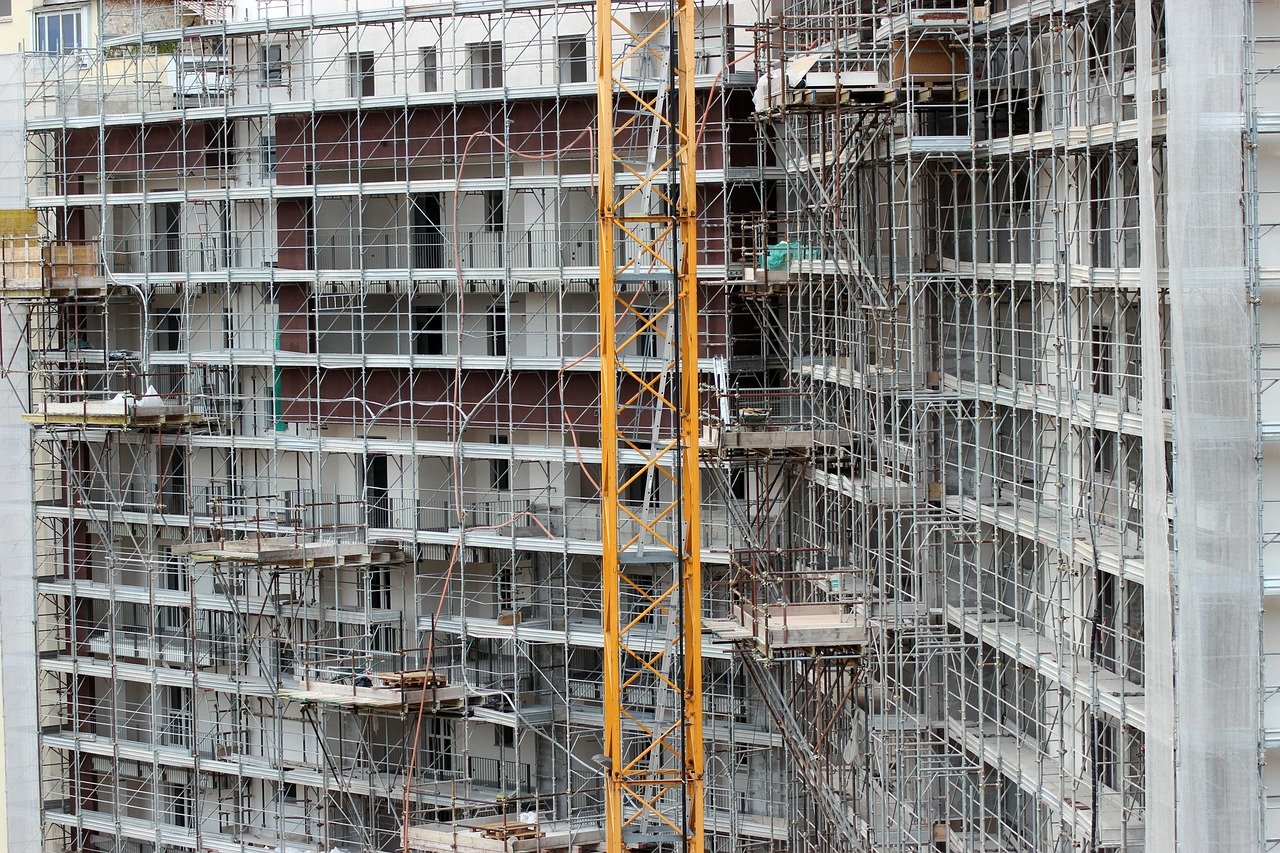
Cantilever scaffolding projects outward from a building without ground-level support — it is the solution your scaffolder reaches for when there is no clear ground beneath the work area.
What Is Cantilever Scaffolding?
A standard scaffold stands on the ground and rises vertically alongside a building. A cantilever scaffold does something different: it extends horizontally from an anchor point on the structure itself, with the working platform projecting out over an obstruction below.
Think of it like a diving board fixed to a building. The platform is held in place by the structure behind it, not by legs standing underneath. This makes it stable where a conventional scaffold would be impossible or impractical to erect.
The term is used loosely in the trade. You might hear it called a cantilever scaffold, a cantilever scaffold tower, or a scaffold tower with cantilever arms — depending on the specific configuration and whether freestanding tower sections are involved.
When Would You Need a Cantilever Scaffold?
Most homeowners encounter this type of scaffolding when something sits between the building and the open ground. The most common situations are:
- Single-storey extensions — a rear extension built right up to the back wall means there is no ground access for standard scaffold legs beneath the upper storey.
- Conservatories — the glass or polycarbonate roof cannot safely take scaffold tube loads, so the working platform must cantilever over it from higher up the main building.
- Party walls and narrow passages — on terraced or semi-detached houses, the gap between properties is sometimes too narrow for a standard scaffold base.
- Public footpaths and roads — where scaffolding would block pedestrian access, a cantilever arrangement can project over the pavement while anchoring to the building, though this normally requires a licence from your local council.
- Obstacles at ground level — fuel tanks, drainage manholes, basement lightwells, or sloped ground that prevents vertical standards being placed directly below the work area.
If you have a rear extension and need roof repairs, rendering, or chimney work above it, there is a reasonable chance your scaffolder will specify a cantilever arrangement. It is a routine solution for exactly this scenario — not an unusual complication.
How Does a Cantilever Scaffold Work?
The exact configuration depends on your building and the specific obstruction, but the principle is consistent: the scaffold is anchored securely to the main structure — often through the walls using through ties — and the platform projects outward from that anchor point.
In residential work, this often means standard tube-and-fitting scaffolding is erected on the ground where possible, with the upper section cantilevering out over the obstacle. The ties into the building carry the load that ground legs would otherwise carry. Your scaffolder will calculate how far the platform can safely project and how many anchor points are needed.
For some situations — particularly where a conservatory sits flush against the rear wall — a scaffold tower with cantilever arms may be used. Here, a freestanding tower is positioned to one side and adjustable cantilever arms extend across the obstruction to create a working platform above it.
All of this is governed by TG20, the industry guide for tube-and-fitting scaffolding, and must comply with the Working at Height Regulations 2005. Your scaffolding contractor should hold NASC membership or be able to demonstrate equivalent competence, and carry out a proper site survey before quoting.
What Does Cantilever Scaffolding Cost?
Cantilever scaffolding costs more than an equivalent standard scaffold because it takes longer to erect, requires more materials, and needs careful planning. As a rough guide, expect to pay a premium of 20–50% over a comparable standard scaffold, though this varies significantly depending on how complex the cantilever arrangement is and how long the hire period runs.
Pricing ranges for typical residential cantilever jobs:
| Job type | Approximate cost range | Notes |
|---|---|---|
| Rear wall access over single-storey extension | £600 – £1,400 | Standard hire of 2–4 weeks. Varies by height and reach required. |
| Gable end or chimney stack over conservatory | £800 – £1,800 | Higher if chimney requires an independent head scaffold above. |
| Cantilever over public footpath (licensed) | £900 – £2,000+ | Includes council licence fee. Varies by local authority. |
| Rear of terrace with narrow party wall access | £500 – £1,200 | Lower if projection is modest; higher with complex tie arrangements. |
These are indicative ranges. Your actual quote will depend on the height of the building, the distance the platform needs to project, local labour rates, and how long the scaffold needs to stay up. To estimate your scaffolding cost based on your specific job, use the free ScaffSource calculator alongside your contractor quotes.
Factors That Affect the Price
Several variables affect how much you will pay for a cantilever scaffold beyond the basic configuration.
Height of the building
A two-storey rear wall costs more to access than a one-storey one — more materials, more time. A four-storey Victorian terrace with a rear return is a more involved job still.
Projection distance
The further the platform needs to reach — across a wide conservatory or a double garage — the more complex and expensive the arrangement. There are practical limits to how far a cantilever can project before a different approach becomes more economical.
Wall construction and tie requirements
Solid brick or stone walls take through-ties straightforwardly. Cavity walls, timber frame, or older properties with weaker masonry may need specialist anchors or alternative tie methods, adding cost and time. Your scaffolder should inspect the wall type before quoting rather than estimating from photographs.
Access to the site
If the scaffolding lorry can pull up and unload directly, costs stay lower. If the crew must carry materials through a narrow side passage or work in a tight rear courtyard, expect a premium for the additional labour involved.
Hire period length
Most scaffolders quote a weekly hire rate beyond the initial period. If your main contractor overruns — which is common — you will pay for extended scaffold hire. Get clarity on the daily or weekly re-hire rate before you sign anything.
Council highway licence
If the scaffold projects over public land, you will need a licence from your local council. Costs vary between local authorities but typically run to £100–£400 for a standard residential job, and can be higher in some London boroughs. Processing can take a week or more, so check early whether this applies to your situation.
Cantilever Scaffold vs Standard Scaffold: Is There a Cheaper Alternative?
Sometimes, yes. It depends on what is blocking the access and how wide the obstruction is.
For a conservatory, there are broadly three options: remove the conservatory roof temporarily (disruptive and not always practical), use a cantilever scaffold over it, or use a scaffold tower with cantilever arms. The tower approach is often cheaper for smaller jobs but can only cover limited reach — typically up to around two metres of projection.
For an extension, a cantilever scaffold is usually the only safe and practical solution. The extension roof is a structural part of your home, and placing scaffold loads directly on it without engineering sign-off is not advisable.
For footpath situations, a gantry — a covered pedestrian walkway underneath the scaffold — is sometimes used on commercial projects. For residential work, a cantilever arrangement is generally more straightforward and cost-effective.
Always ask your scaffolding contractor to explain why they have specified a cantilever arrangement and whether any alternative would be safe and practical for your job. A clear, confident answer to that question is a good sign you are dealing with a competent firm.
Questions to Ask Before You Book
When getting quotes for a job that may need cantilever scaffolding, ask the following:
- Have you surveyed the site in person, or is this quote based on photos or measurements I have provided?
- Does the quote include all tie work, and what method will you use given my wall construction?
- Is a council highway licence required, and if so, who applies for it and at what cost?
- What is the weekly re-hire rate if the scaffold needs to stay up longer than planned?
- Will you provide a scaffold tag and handover certificate on completion?
- Are you a member of NASC or registered with a recognised scaffolding trade body?
A scaffolder who cannot answer these clearly is one worth walking away from. Before you commit to a booking, get an instant price for your job so you have a benchmark to compare quotes against.
The Short Version
Cantilever scaffolding is used when standard scaffold legs cannot reach the ground — most commonly over rear extensions, conservatories, party walls, or public footpaths. It costs more than a standard scaffold, typically 20–50% more, with most residential jobs falling somewhere in the £600–£1,800 range depending on height, reach, and complexity.
Get at least two or three quotes from contractors who have visited the site, confirm whether a council licence is needed, and check the weekly re-hire rate before signing. For more guidance on scaffolding costs and job types, browse the ScaffSource blog.