Chimney scaffold hire is one of the most common domestic scaffolding jobs in the UK, and one of the easiest to get wrong.
A chimney stack sits at the highest point of your roof, often 8 to 12 metres above ground on a standard two-storey house. Any meaningful repair or maintenance work — repointing mortar joints, replacing a pot or flaunching, renewing lead flashing — requires safe access under the Working at Height Regulations 2005. Most roofers and chimney specialists won't take the job without proper scaffolding in place. This guide covers the three main types of chimney scaffolding, when each is appropriate, and what you should realistically expect to pay.
Three Types of Chimney Scaffold — and When Each Is Used
Not every chimney job calls for the same access solution. The right approach depends on where the chimney sits on the roof, how high the property is, what the tradesperson needs to do once they're up there, and whether ground-level access is available around the building.
Full-Height Independent Scaffold
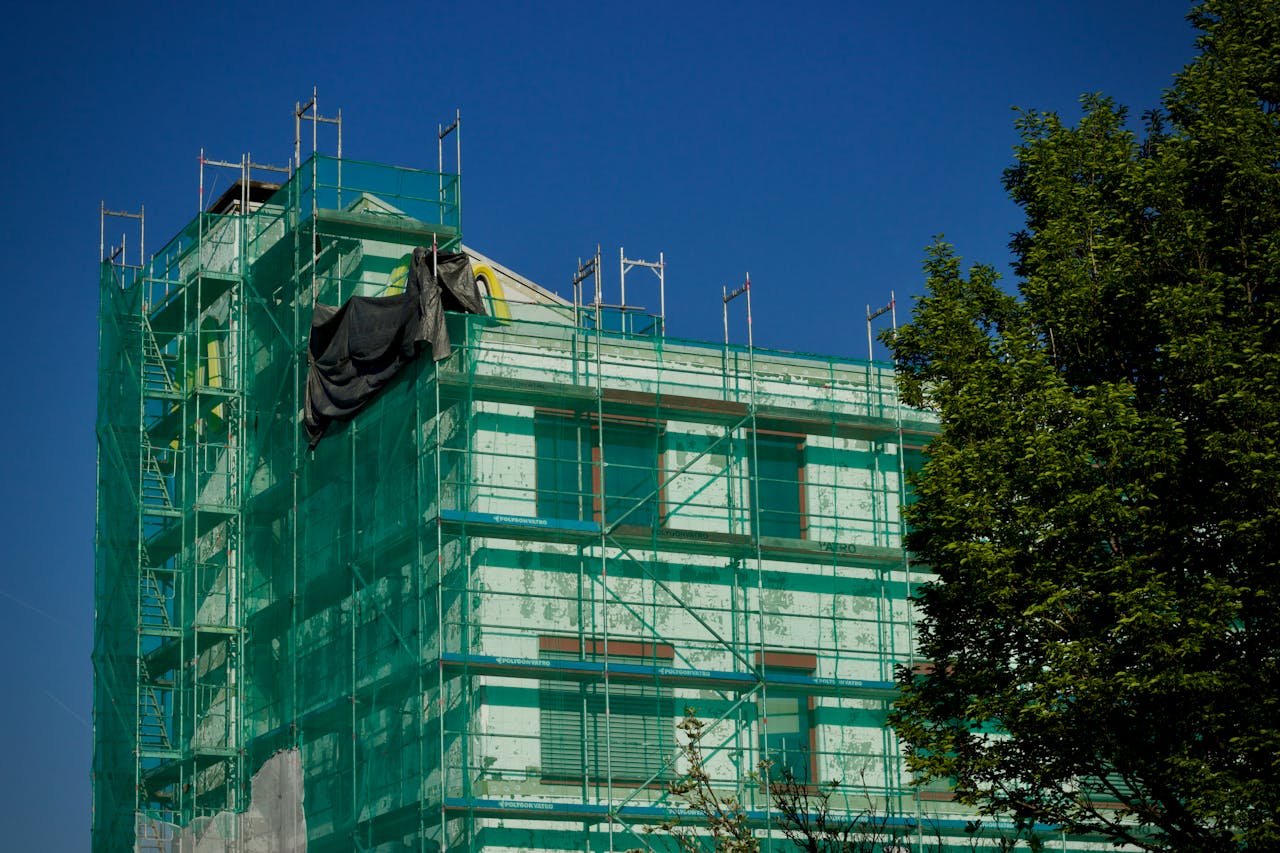
This is a free-standing scaffold structure erected against the side of the property, rising from the ground up to eaves or ridge height. It's the most common approach for chimney work on semi-detached and terraced houses, particularly where the stack rises from a party wall or gable end.
Full-height scaffolding gives tradespeople a stable working platform at chimney height, with room to work safely on multiple faces of the stack. It's the right choice for anything more involved than a minor repair — lead flashing replacement, significant repointing, stack rebuilds, or chimney breast removal from above. Most scaffolding companies default to this option because it's the most adaptable and the most familiar to the trades using it.
Chimney Scaffold Tower
A chimney scaffold tower — sometimes called a chimney access tower — is a narrow, purpose-built aluminium tower erected on the roof slope adjacent to the chimney stack. Rather than running scaffolding up from ground level, the tower sits on the roof and is stabilised against the stack itself.
This approach works well for:
- Straightforward pot replacements or cowl fitting
- Chimney cap repairs or repointing on a single face
- Mid-terrace properties where there's no side access for ground-level scaffolding
- Jobs where the scope is genuinely limited and quick
Chimney scaffold towers cost considerably less to hire and erect than full ground-level scaffolding, but they're only appropriate where the work is limited in scope and the roof slope is safely accessible via a proper roof ladder from another point on the roof. Your roofer will advise which is suitable — but be wary of any tradesperson who always defaults to the cheapest access option regardless of what the job actually involves.
Cantilever Scaffold
Where a chimney sits in the middle of a roof slope and there's no practical way to erect a scaffold tower or bring scaffolding up from the ground in a conventional configuration, a cantilever arrangement can extend an access platform out from an adjacent scaffold run to reach the stack.
Cantilever scaffolding is less common on domestic jobs and tends to be used on larger or more complex properties — detached houses with central ridge-mounted chimneys, for example, or period buildings with unusual roof geometry. It requires careful structural consideration and will carry a premium over standard access methods.
Chimney Scaffold Costs: What to Expect in the UK
Prices for chimney scaffolding vary considerably depending on which type of access is needed, how high your property is, how long the scaffold will be in place, and where in the country you are. Regional labour rates play a significant part — scaffold erection in London and the South East typically costs more than the same job in the Midlands, North West, or Yorkshire.
The table below gives a realistic guide to typical price ranges for chimney scaffold hire in England and Wales. These are indicative ranges, not fixed prices — your final quote will reflect your specific property and job scope. To work out a more accurate figure for your situation, get an instant price for your job using the ScaffSource calculator.
| Scaffold Type | Typical Cost Range | Best Suited For |
|---|---|---|
| Chimney scaffold tower (roof-mounted) | £300 – £700 | Minor repairs, pot replacement, simple repointing |
| Full-height scaffold (1–2 lifts) | £600 – £1,400 | Standard semi-detached or terrace, most chimney repairs |
| Full-height scaffold (3+ lifts, larger property) | £1,200 – £2,500+ | Detached houses, tall Victorian or Edwardian properties |
| Cantilever or complex bespoke arrangement | £1,500 – £3,500+ | Central roof stacks, restricted access, complex builds |
These figures generally cover erection, a standard hire period, and dismantling. Most scaffolding companies quote chimney work as a package rather than itemising each component separately, so always confirm what's included before accepting a quote.
What Drives the Price Up or Down
Several factors will move your quote within — or beyond — the ranges above.
- Property height and number of storeys — a three-storey Victorian terrace needs significantly more scaffold than a standard two-storey new build. Extra lifts mean more materials and more erection time.
- Chimney position and access — a rear chimney with no vehicle access for a scaffold lorry, or a stack on a gable end with limited footprint, adds both cost and planning complexity.
- Hire duration — most chimney scaffold hire quotes cover a two- to four-week period. Extensions are charged on a weekly or fortnightly basis. Clarify the re-hire terms before agreeing to anything, especially if your roofer's schedule is flexible.
- Pavement licence — if any part of the scaffold extends over a public footpath, a highway licence from the local council is required. This typically adds £50–£200 and is usually passed on within the quote.
- Debris netting or sheeting — required if the chimney overhangs a neighbour's property or a public walkway. Not always included as standard, so ask specifically.
- Time of year — spring and summer bring higher demand for all roofing and scaffolding work. Prices rarely rise significantly, but waiting times do, which may translate into extended hire periods if your roofer is delayed.
- Location — London, the South East, and large city centres carry higher labour rates. Edinburgh and Glasgow tend to sit above the Scottish average.
How Long Will Chimney Scaffold Hire Last?
The actual repair work on a chimney rarely takes more than one or two days once a tradesperson is on site. But scaffold hire is almost never sold by the day — the minimum period for a domestic job is typically two weeks, and many companies price on a four-week basis as standard.
In practice, this means the scaffold cost is largely fixed regardless of whether the repair takes half a day or a full week. The variable is what happens if the hire period runs out before the work is done — something that happens when weather causes delays or a roofer's schedule shifts at the last minute. Before agreeing to a quote, ask what the extension rate is, whether extensions are charged in whole days or weeks, and how much notice you need to give.
If you're arranging the scaffold hire directly rather than leaving it to your roofer, make sure both sides have confirmed a firm date for the tradesperson to be on site before the scaffold goes up. A scaffold sitting idle while you wait for a roofer to become available is expensive dead time.
What's Typically Included in a Chimney Scaffolding Quote
A properly written chimney scaffolding quote should cover:
- Delivery of all materials, erection on the agreed date, and dismantling at the end of the hire
- All tubes, boards, fittings, base plates, and guard rails
- A working platform at chimney height with toe boards and handrails on open edges
- Any required pavement or highway licence where the scaffold overhangs a public footpath
Items that may or may not be included — worth asking about specifically:
- Debris netting or protective sheeting
- Loading bays or materials hoists
- Additional scaffold runs to cover more than one chimney stack on the same property
Materials for the repair itself — replacement pots, lead flashing, mortar, or pointing material — are supplied and costed separately by your roofer or chimney specialist. These won't appear on a scaffolding quote.
Permissions and Neighbour Considerations
Scaffolding for chimney repair does not require planning permission. However, if any part of the structure overhangs a public footpath or road — common when scaffolding the front or side of a terraced or semi-detached house — your scaffolding company needs a licence from the local highway authority. Reputable companies handle this as part of their service; always confirm it's included and allow a few extra days for approval if your council has a longer processing time.
If the scaffold needs to be fixed to, or erected on, a neighbour's land — for example, where the chimney sits on a party wall — you may need to serve notice under the Party Wall etc. Act 1996. This is more common than many homeowners expect on terraced and semi-detached properties. A good scaffolding company will flag this early, but your roofer or a surveyor can advise if you're unsure.
Getting the Best Quote for Scaffold for Chimney Repair
Always get at least two quotes. Scaffolding prices vary meaningfully between companies even for identical jobs, and a lower figure doesn't automatically mean worse quality or safety. What matters is that the quote is complete — specifying the scaffold type, number of lifts, hire period, and whether the pavement licence is included where needed.
Look for companies affiliated with the National Access and Scaffolding Confederation (NASC) or who work to the TG20 guidance for tube and fitting scaffold. NASC members are audited for safety and competence, which provides useful assurance on domestic jobs as much as commercial ones. You can search for members by postcode on the NASC website.
Before your quotes arrive, see what your project should cost using the ScaffSource calculator — it gives you a realistic ballpark based on your property type and job description, so you can judge quickly whether any quote is competitive or wide of the mark.
The Short Version
Chimney scaffolding is almost always needed for any significant repair or maintenance work at stack height. Most domestic jobs use either a roof-mounted chimney scaffold tower for minor work or a full-height independent scaffold for anything more substantial. Costs typically run from around £300 for a basic tower hire to £2,500 or more for a tall or complex property.
The biggest variables are your property's height, the chimney's position on the roof, how long the scaffold needs to stay up, and regional labour rates. Get at least two quotes, confirm exactly what each one covers, and agree the extension rate upfront in case your roofer is delayed. You'll find more guides to scaffolding costs and job types on the ScaffSource blog.