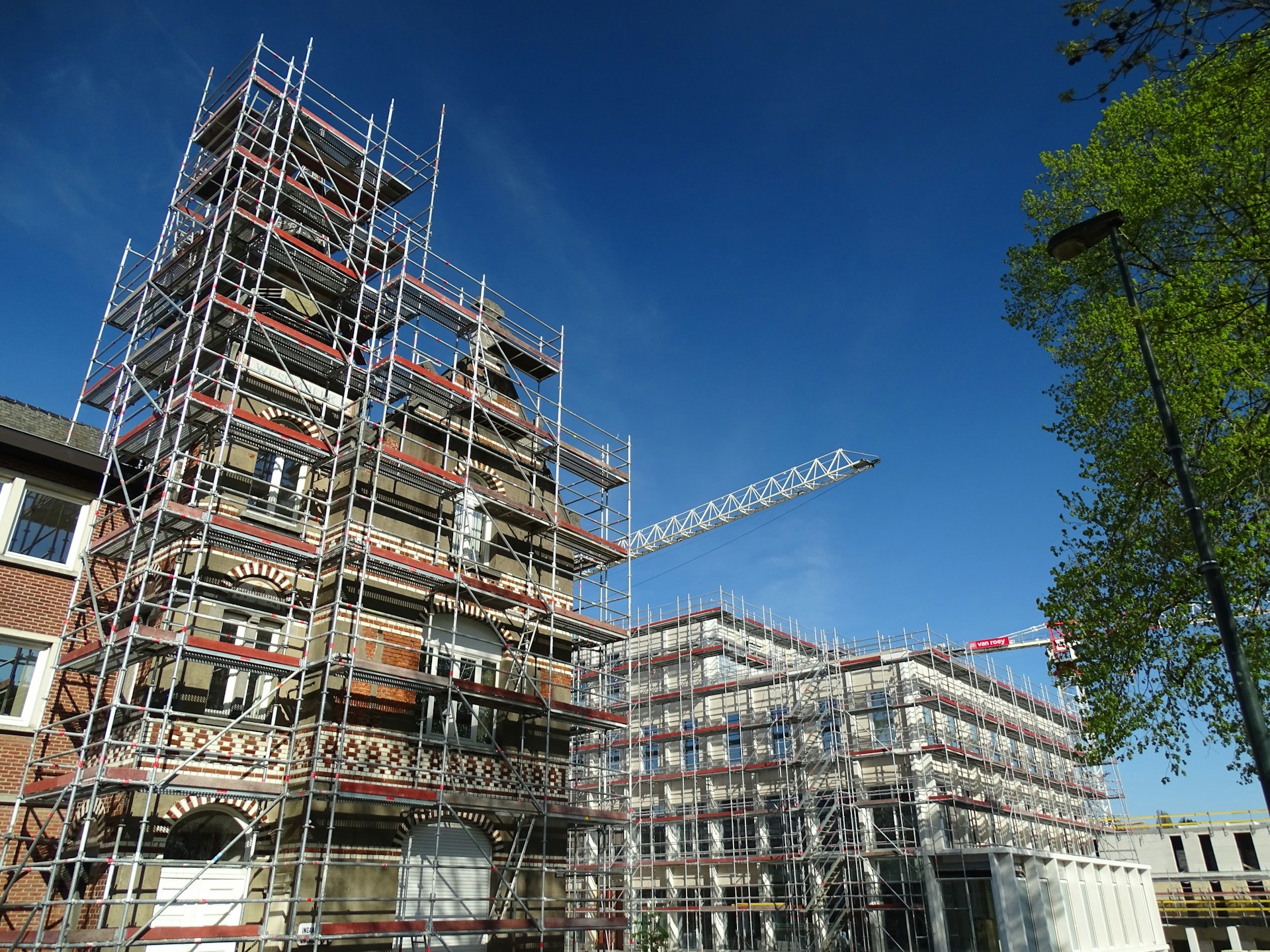
Scaffolding for a terraced house typically costs between £600 and £2,500 — the exact figure depends on the job, the property, and your location. The cost of scaffolding for a terraced house is shaped by everything from building height and frontage width to how long the scaffold needs to stay up and whether a pavement licence is required.
Why Terraced Houses Have Unique Scaffolding Challenges
Terraced houses share walls on both sides, which means scaffolders are almost always working with limited access. There is rarely a side return to wheel materials through. The front garden — if there is one — may be a metre deep or less, and the pavement itself might be the only staging area available, which brings in the need for a licence from the local council.
These constraints do not necessarily push costs up dramatically, but they do matter. A compact Victorian terrace in Manchester or Birmingham will need the same kind of scaffold as a semi-detached in the same street, but the logistics are tighter. Wider frontage properties, or those with a small passageway at the side, give scaffolders a little more room to work with.
If your property shares a boundary with a neighbour and the scaffold needs to cross that boundary — even just a board — you will need their permission. In some cases, party wall considerations apply if the scaffold needs to be fixed to a shared structure. It is worth having that conversation with your neighbour before booking any work.
What Affects the Scaffolding Cost for a Terraced House
Several factors move the final price up or down:
- Height — a two-storey terrace needs more scaffold than a single-storey extension. A three-storey end-of-terrace costs more again.
- Width of the frontage — a 4-metre-wide Victorian back-to-back needs less material than a 7-metre Edwardian terrace.
- Duration of hire — most quotes include two to four weeks. Every week beyond that adds a hire charge, typically £50–£150 per week depending on the size of the scaffold.
- Type of work — chimney-only jobs use a smaller, lighter scaffold than a full front elevation re-roof.
- Pavement licence — if the scaffold overhangs or sits on the public pavement, the contractor applies for a licence from the local authority. This usually costs £50–£200 and is passed on to you.
- Location — scaffolding in London and the South East typically costs 20–40% more than equivalent work in the North of England, Scotland, or Wales.
To get a more precise figure for your job, you can estimate your scaffolding cost using the free calculator — it accounts for the variables above and gives you a realistic range before you speak to a contractor.
Typical Costs by Job Type
The table below covers the most common reasons terraced house owners need scaffolding. These are approximate ranges based on a standard two-storey mid-terrace; prices shift for taller or wider properties.
| Job Type | Typical Scaffold Cost | Hire Period Included |
|---|---|---|
| Chimney repair or repointing | £600–£1,000 | 1–2 weeks |
| Re-roof (full front slope) | £900–£1,600 | 2–4 weeks |
| External render (full front elevation) | £900–£1,800 | 2–4 weeks |
| External painting or redecoration | £700–£1,400 | 1–3 weeks |
| Gutter and fascia replacement | £600–£1,100 | 1–2 weeks |
| Full front elevation (combined works) | £1,200–£2,500 | 3–6 weeks |
If you are having multiple jobs done at the same time — say, a re-roof and new gutters — it nearly always makes sense to do them while the scaffold is already up. The marginal cost of adding extra days to the hire is much lower than paying for two separate scaffold erections.
Chimney Scaffolding on a Terraced House
Chimney stacks on terraced houses often sit directly above the party wall, straddling the ridge between two properties. This can complicate access: the scaffold either approaches from the front slope or, less commonly, from the rear if there is back-alley access.
For a straightforward chimney repair or repointing job, a chimney scaffold platform is the most common solution. It uses the roof slope as a base and erects a small working platform around the stack. This is faster and cheaper than a full front elevation scaffold, which is why chimney-only jobs sit at the lower end of the cost range.
If the chimney stack is tall, severely deteriorated, or needs a full rebuild, a more substantial scaffold will be required. A crumbling chimney that needs scaffold up the full front of the house will cost considerably more than a simple repointing job.
Scaffolding for a Full Re-Roof
A full re-roof on a two-storey terrace requires scaffold that covers the front slope, gives roofers safe access to the ridge, and provides somewhere to store materials like slates or tiles. The scaffold will typically span the full width of the property, sitting at eaves level with a working platform and guard rails.
Rear access is often limited on a terrace — back-to-backs have no rear access at all, and many terraces have only a narrow yard. Where the rear slope also needs work, this adds to the cost because the contractor either needs to bring materials through the house or erect a separate scaffold at the rear.
Expect the hire period for a re-roof to run two to four weeks. If the work takes longer — poor weather, discovery of structural problems, supply delays — you will pay weekly extension charges. Ask your scaffolding contractor upfront how they handle extensions and what the weekly rate is.
Scaffolding for Render and External Painting
Rendering or painting the front elevation of a terraced house uses a different kind of scaffold to a roof job. Rather than needing height access to the ridge, render scaffolding needs to cover the full face of the building, giving tradespeople a series of working lifts at different heights.
The cost scales with the width of the frontage and the number of storeys. A narrow Victorian terrace with a 4-metre frontage will cost noticeably less to scaffold than a wider Edwardian property. Three-storey terraces — common in inner-city areas — push the cost towards the upper end of the range or beyond.
For properties in conservation areas or on streets where the scaffold footprint is tight, extra care may be needed around overhead cables, street furniture, or trees. These complications rarely add huge cost, but they do add time, which can mean additional hire charges.
How Long Does It Take to Put Scaffolding Up on a Terraced House?
For a standard two-storey mid-terrace, erection typically takes between two and four hours. A small chimney scaffold might be up in an hour or two. A full front elevation with a pavement gantry or additional rear access could take a full working day.
The question of how long to put scaffolding up on a terraced house is often less relevant than how long it stays up. Erection and dismantling are included in the quoted price; what you pay extra for is hire beyond the included period.
If you need scaffold quickly — an emergency roof repair after a storm, for instance — most contractors can mobilise within 24 to 48 hours for a straightforward job. Ask whether any urgency surcharge applies and get that figure confirmed in writing.
Getting Quotes and Checking Credentials
Always get at least two or three quotes before committing. Scaffolding prices vary between contractors, and a difference of more than 20–25% is worth querying rather than automatically choosing the cheapest.
Ask whether the contractor is a member of the NASC (National Access and Scaffolding Confederation) or works to TG20 guidance for tube-and-fitting scaffolds. Any reputable contractor should carry public liability insurance and be able to show you the certificate. The HSE's Working at Height Regulations 2005 set the legal framework for scaffolding design and inspection; a professional will know these without prompting.
A good quote should specify the type and size of scaffold, the hire period included, the weekly extension rate, who handles the pavement licence if applicable, and the dismantling timeline. A quote that just lists a total price with no breakdown is a warning sign.
Before you ring around, see what your project should cost so you arrive at those conversations with a realistic figure already in mind. You will also find more useful pricing guides on the ScaffSource blog.
The Short Version
- Most scaffolding jobs on a terraced house cost between £600 and £2,500, with the final price driven by job type, property size, hire duration, and location.
- Access constraints — narrow fronts, no side return, shared boundaries — are common with terraced properties and affect logistics, though they rarely push the price dramatically higher on their own.
- Combining multiple jobs while the scaffold is already up saves money compared to booking separate erections.
- Erection on a standard two-storey terrace takes two to four hours; extended hire beyond the included period adds a weekly charge.
- Get at least three quotes, check NASC membership and public liability insurance, and use the calculator to arrive at negotiations with a realistic figure already in mind.