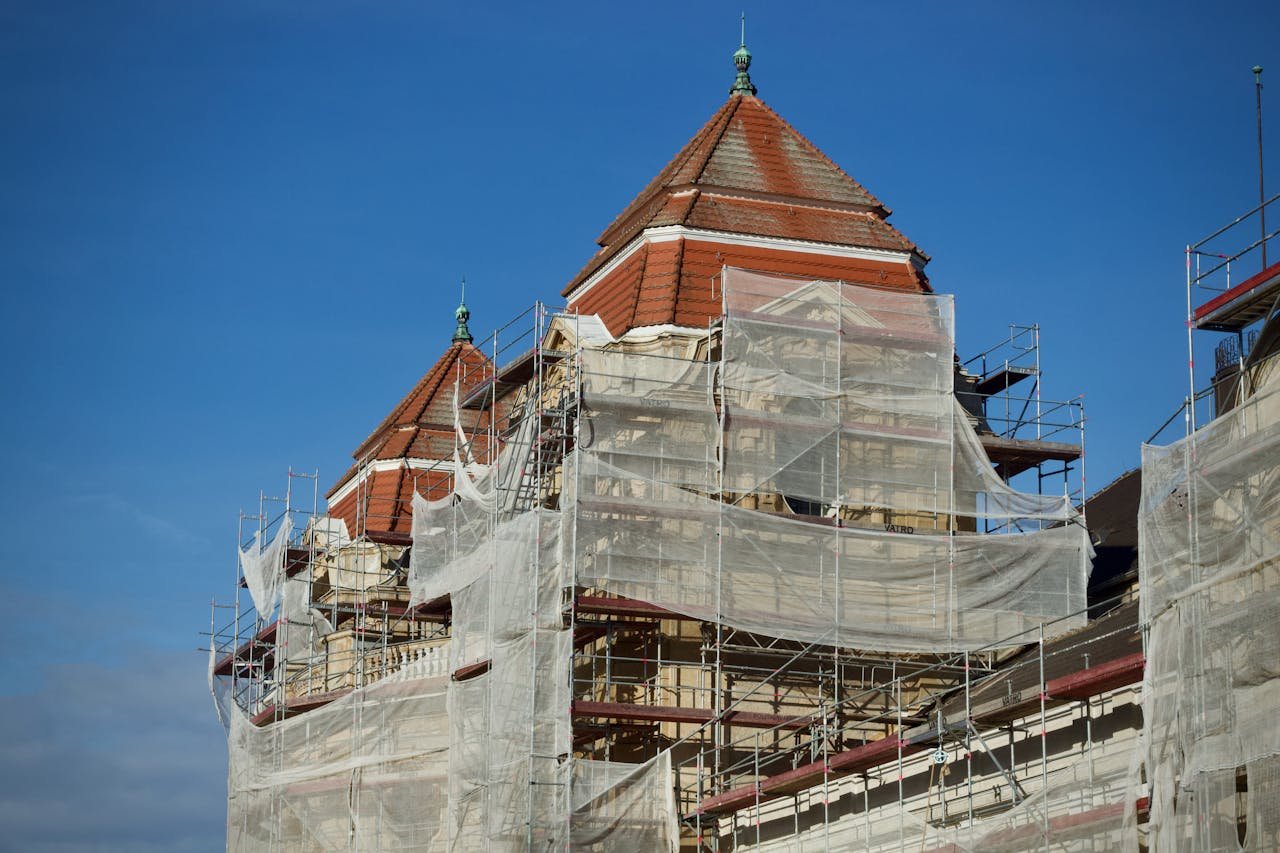
Most roof repairs do need roof scaffolding — but not every one. The answer depends on the pitch of your roof, the size of the job, and how many trips up and down the work requires.
When a Ladder Is Enough
A competent roofer using a properly secured ladder can handle some minor jobs safely — but only within tight limits. The Health and Safety Executive (HSE) and the Working at Height Regulations 2005 allow ladder use where the risk is low, the task is brief, and there is no need to carry heavy materials.
A single-tile replacement on a low-pitch roof, accessible from the eaves, might qualify. If the job can genuinely be completed in one or two trips, with light tools and a single replacement slate or tile, a ladder may be acceptable.
In practice, most roofers who take their obligations seriously will not commit to ladder-only working unless:
- The roof pitch is 30 degrees or less
- The repair is at or near eaves level — not at the ridge
- No heavy materials need lifting to the roof
- The task can be completed in a single short visit
- There is a safe landing area below with no public access
If any of these conditions are not met, scaffolding is the expected approach — and often the legally required one.
When Roof Scaffolding Is Legally Required
The Working at Height Regulations 2005 place the legal duty on the person in control of the work — your roofer, or you as the client if you are managing the project directly. The regulations do not specify a height above which scaffolding becomes mandatory, but they do require that any work at height is planned, supervised, and carried out in a manner that prevents falls.
In practice, roof scaffolding becomes necessary — and a responsible roofer will insist on it — in the following situations.
Multiple visits or a longer project
Re-roofing, replacing large sections of felt and battens, repointing a chimney stack, or replacing a full run of ridge tiles all require multiple trips and sustained working at height. A ladder is not a safe working platform for anything beyond a brief, one-off task.
Carrying materials up to the roof
Tiles, slates, lead flashing, felt rolls, and bags of mortar are heavy. The HSE is clear that manual handling of materials on ladders significantly increases the risk of a fall. Scaffolding gives roofers a stable platform to work from and somewhere to stage materials safely before they go up.
Ridge, chimney, and gable-end work
Anything at the apex of the roof — ridge tiles, chimney pointing, leadwork around a chimney stack — is far beyond comfortable ladder reach on most properties. A full scaffold, or at minimum a chimney scaffold, is standard practice for this kind of work.
Full or partial re-roofing
A complete or partial re-roofing job will almost always require full perimeter scaffolding. Roofers need space to move around the roof safely, and old material needs somewhere to go before it reaches the skip. Scaffold boards serve as a staging area for both waste and new materials.
If you are getting quotes for any of the above jobs and one contractor says they can do it without scaffolding, that should prompt a careful conversation about how they are managing the risk — not just a price comparison.
You can estimate your scaffolding cost using the free ScaffSource calculator before you gather quotes — it helps you check whether what you are being charged sits in the right ballpark.
What Roofers Expect from a Scaffold
A scaffold designed for roofing work is not just a way of reaching the roof. It is a working platform and a materials-handling system. When you arrange scaffolding for a roofer, the scaffold contractor will usually liaise directly with them to confirm it is suitable — but it helps to know what is typically needed.
- Full eaves-height working platform: boards at eaves level so the roofer can stand safely and reach up to the roof surface without overreaching
- Guardrails and toe-boards: required to prevent falls and stop tools or displaced tiles rolling off the platform
- Ladder access: a scaffold staircase or access ladder built into the structure for safe entry and exit
- Chimney scaffold: if chimney work is included, a separate scaffold around the stack is usually needed in addition to the main structure
- Waste clearance space: large re-roofing jobs produce significant waste — the scaffold layout should allow for this
Most standard residential scaffolds for a semi-detached or terraced house include these elements as standard. If your property is detached with a hipped roof, or has multiple roof levels, the scaffold specification will be more involved and the quote will reflect that.
How Much Does Roof Scaffolding Cost?
Roof scaffolding costs vary considerably depending on the size and shape of your property, how long the scaffold is needed, and where you are in the UK. London and the South East tend to be the most expensive; Scotland, Wales, and the North of England are generally cheaper.
The table below gives a rough sense of what homeowners typically pay for roof scaffolding hire, including erection and dismantling:
| Property type / job | Typical hire cost (1–2 weeks, incl. erection and strike) |
|---|---|
| Small terraced house, one elevation | £500 – £900 |
| Semi-detached, one or two elevations | £700 – £1,400 |
| Detached house, full perimeter | £1,200 – £2,500 |
| Chimney scaffold only | £300 – £700 |
| Victorian terrace, front elevation only | £600 – £1,100 |
These are indicative ranges — the actual cost depends on specifics that the calculator can factor in for your particular job. If the scaffold needs to stand on a public pavement, a local authority licence will add to the cost; in busy urban areas this can take a week or more to arrange, so factor that into your project timeline.
Daily Hire vs Fixed-Price Contracts
Most residential scaffold quotes are fixed-price, covering erection, a set hire period (typically two weeks), and dismantling. If your roofer needs extra time — because of poor weather or a job that turns out to be bigger than expected — additional hire charges accrue. These are typically £20–£60 per day depending on the scaffold size and location.
Be clear with your roofer upfront about who is responsible for arranging the scaffold and who pays if it overruns. In most cases the roofer will either arrange it directly or ask you to organise it ahead of their visit. Either way, agree it in writing.
Finding Roof Scaffolding Near You
Searching for roofing scaffolding near me or scaffolding for roofers near me will return both scaffold-only companies and roofing firms that subcontract the scaffolding element. Either route can work — the important thing is that the scaffold is erected by a competent contractor, ideally one whose operatives hold CISRS cards (the Construction Industry Scaffolders Record Scheme).
Check that the scaffold contractor carries adequate public liability insurance. If the scaffold sits on a public pavement or overhangs a shared boundary, this matters more than it would for a purely private installation. Ask to see proof of cover before work begins.
More guidance on comparing quotes and choosing contractors is available in the pricing guides on the ScaffSource blog.
A Note for Landlords and Insurance Jobs
If you are a landlord arranging roof repairs on a rental property, the same rules apply — but the documentation stakes are higher. Your roofer's method statement should specify how they are managing the risk of working at height, and scaffolding should be reflected in that plan. Insurance companies handling storm-damage claims will sometimes query scaffold costs; a signed quote and invoice from a NASC-registered contractor is good protection against any dispute.
Before you agree any quote, get an instant price for your job with the ScaffSource calculator — it takes less than a minute and gives you a clear baseline to measure quotes against.
The Short Version
For the vast majority of roof repair and re-roofing jobs, scaffolding is required — legally and practically. Ladders may be acceptable for a single-tile replacement at low eaves on a shallow-pitch roof, but anything more complex, higher up, or involving carried materials needs a proper scaffold.
Roof scaffolding for a typical UK house costs somewhere between £500 and £2,500 depending on the size of the property and how long the hire runs. The cost is usually included in your roofer's total quote — but knowing what is reasonable means you are not overcharged, or worse, underserved by a contractor who has skipped the scaffold to win the job on price.
Get quotes from at least two CISRS-accredited scaffold contractors, make sure your roofer has a clear method statement for working at height, and check whether a pavement licence is needed before work starts.