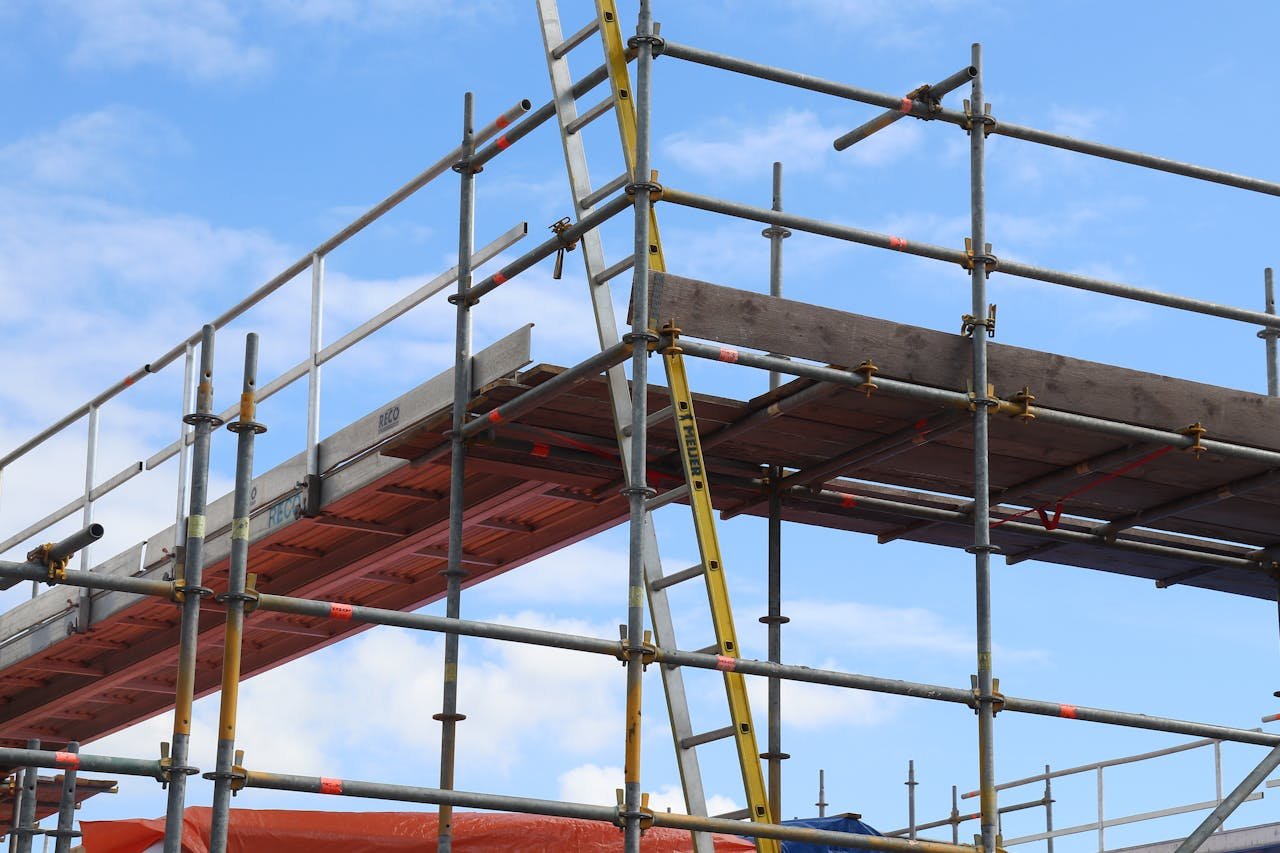
Most loft conversions need scaffolding from the moment builders start working on the roof structure. The scaffolding cost for a loft conversion typically falls between £500 and £2,500 on a standard UK semi-detached or terraced house — the range is wide because the conversion type, your property's height, and how long the hire runs all make a significant difference to the final bill.
Why Almost Every Loft Conversion Needs Scaffolding
Any work that involves opening up or altering the roof structure happens at height. The Working at Height Regulations 2005 place a clear duty on contractors to provide safe access for anyone working above ground level, and for roof-level work that means a properly erected scaffold.
Even the most modest Velux conversion requires roofers to work on a pitched slope while cutting openings and setting frames. A dormer or hip-to-gable job is considerably more involved — you'll typically see a working platform at eaves height, often with projecting fans to catch debris before it reaches the garden below.
Your main contractor will usually co-ordinate scaffolding as part of the overall build programme. But understanding what's included in your quote — and roughly what the scaffold element is worth — makes it much easier to compare tenders on a like-for-like basis.
Scaffolding Cost Loft Conversion: Typical Price Ranges
The table below gives realistic hire-cost estimates for a standard two-storey UK semi-detached or terraced house. Properties with difficult access, taller eaves, or more complex roof geometry will generally sit at the upper end of the range or beyond it.
| Conversion type | Typical scaffold configuration | Estimated hire cost |
|---|---|---|
| Velux (rooflight) | Rear elevation, single lift | £500–£900 |
| Rear dormer | Rear scaffold with working platform and fans | £900–£1,600 |
| Hip-to-gable | Side and rear scaffold, higher lift | £1,000–£1,900 |
| L-shaped dormer | Rear and side elevation, larger platform | £1,200–£2,200 |
| Mansard | Full rear scaffold, often with overhead protection | £1,500–£2,800 |
These figures cover erection, a standard hire period of four to eight weeks, and dismantling. Weekly continuation charges apply if the build runs over. To get a figure specific to your property and project type, you can estimate your scaffolding cost using the free ScaffSource calculator.
How Your Conversion Type Affects the Scaffolding
The structure and scale of scaffolding needed depends heavily on what kind of loft conversion you're having. Here's how the main options compare.
Velux (rooflight) conversions
A Velux conversion keeps the existing roof pitch largely intact and adds rooflights flush with the slope. It's the least disruptive option structurally, and the scaffolding requirement reflects that. You'll usually need a single-lift scaffold along the rear elevation to give roofers safe footing while they cut openings, fit flashings, and bed the frames. Hire typically runs four to six weeks.
Rear dormer conversions
The rear dormer is by far the most common type across the UK. A section of the rear roof slope is removed and replaced with a box-dormer structure — a vertical-faced addition with a flat or low-pitched roof that significantly increases the usable floor area. Because builders are removing and reconstructing part of the roof, a more substantial scaffold is needed: a working platform at eaves height, fans to catch falling debris, and handrails and toe boards along the working deck. Hire periods of six to eight weeks are typical, longer if steelwork or roofing materials cause delays.
Hip-to-gable conversions
This type is common on end-of-terrace and semi-detached houses where one side of the roof hips inward rather than finishing at a vertical gable. The hip is removed and a new gable wall is constructed — usually significant structural work. You'll need scaffolding on the side elevation as well as the rear, making the overall structure larger and slightly more costly to erect. Expect six to ten weeks on site.
L-shaped dormer conversions
Particularly common on Victorian terraces with a rear back-addition (the lower section that typically houses the kitchen or a bathroom), an L-shaped dormer extends across both the main rear roof and the back-addition roof. The scaffold needs to cover both sections, so the working platform is larger and the structure more complex. Budget toward the upper end of the price range.
Mansard conversions
A mansard involves changing the pitch of the entire rear roof to near-vertical, creating a large, box-like addition. Because the structural work is extensive and the scaffold must stay in place throughout brickwork, waterproofing, and finishing, this is the most demanding type in terms of scaffolding. Hire periods of eight to twelve weeks are not unusual, and overhead protective fans are often part of the specification.
How Long Will the Scaffolding Be Up?
For most loft conversions, the scaffold will be on site for between four and ten weeks. That spread reflects the complexity of the build, how the contractor sequences the work, and the weather — roofing and brickwork typically pause in heavy rain or high winds, which can push out the programme.
A well-run Velux conversion on a compact property might have the scaffold down in under four weeks. A full mansard or L-shaped dormer on a Victorian terrace, with structural steelwork and multiple trades involved, could comfortably run to ten weeks or more.
Ask your contractor how many weeks of scaffold hire are included in their quote. Most scaffolding companies apply a weekly continuation charge once the included period expires — typically £50 to £150 per week depending on the size of the structure. A job that overruns by a fortnight can add a meaningful amount to the final bill, so it's worth pinning this down before work starts.
What Else Affects the Loft Conversion Scaffolding Cost?
Beyond conversion type and hire duration, several other variables will influence what you pay:
- Property height. A three-storey house or one with unusually tall eaves requires more scaffold tube, more fittings, and more labour to erect safely. Victorian townhouses can be considerably more expensive than a standard 1930s semi.
- Site access. If scaffolders can't park a lorry close to the property, expect a surcharge for the extra time. Narrow side passages, rear-access-only gardens, and congested town-centre streets all add cost.
- Pavement or highway licences. If any part of the scaffold footprint crosses a public pavement or road, a licence from the local council is required. Costs vary but typically run from £100 to £300. Some councils take time to process applications, so this is worth raising with your contractor early.
- Shared boundaries. On a semi-detached or terraced house, the scaffold may need to be positioned close to a neighbour's land. The Party Wall Act may also apply depending on the nature of the structural work — your contractor should flag this if relevant.
- Regional rates. Scaffolding labour is most expensive in London and the South East, where day rates can run 20–30% above the UK average. Prices in the North of England, Scotland, Wales, and Northern Ireland are generally lower.
How Scaffolding Should Appear in Your Quote
Most builders include scaffolding as a single line within their overall loft conversion quote rather than breaking it out in detail. That's normal practice, but it makes comparing tenders harder. If one contractor includes eight weeks of hire and another includes four, the quotes aren't on an equal footing.
Ask every contractor you speak with to confirm the following:
- Whether scaffolding is included in the quoted price
- How many weeks of hire are covered
- What the weekly continuation charge is if the build runs over
- Whether pavement licence fees are included or charged separately
If you're managing the project yourself and sourcing scaffolding independently, look for contractors who are members of NASC — the National Access and Scaffolding Confederation. NASC members work to TG20 guidance for tube-and-fitting scaffold design, which sets out industry standards for safe residential and commercial structures.
Before approaching contractors, see what your project should cost with the ScaffSource calculator — it gives you a realistic baseline so you can assess whether the scaffolding element of any quote looks reasonable.
What to Do Next
The scaffolding cost for a loft conversion runs from roughly £500 for a straightforward Velux job on a standard semi up to £2,500 or more for a full mansard or L-shaped dormer on a taller property. Hire duration is typically four to ten weeks, with weekly charges if the build overruns.
The key things to check in any quote: is scaffolding included, how many weeks of hire are covered, and are pavement licence costs accounted for? Getting that detail upfront avoids surprises at the end of the build. There are more guides on scaffolding costs for different types of work over on the ScaffSource blog.