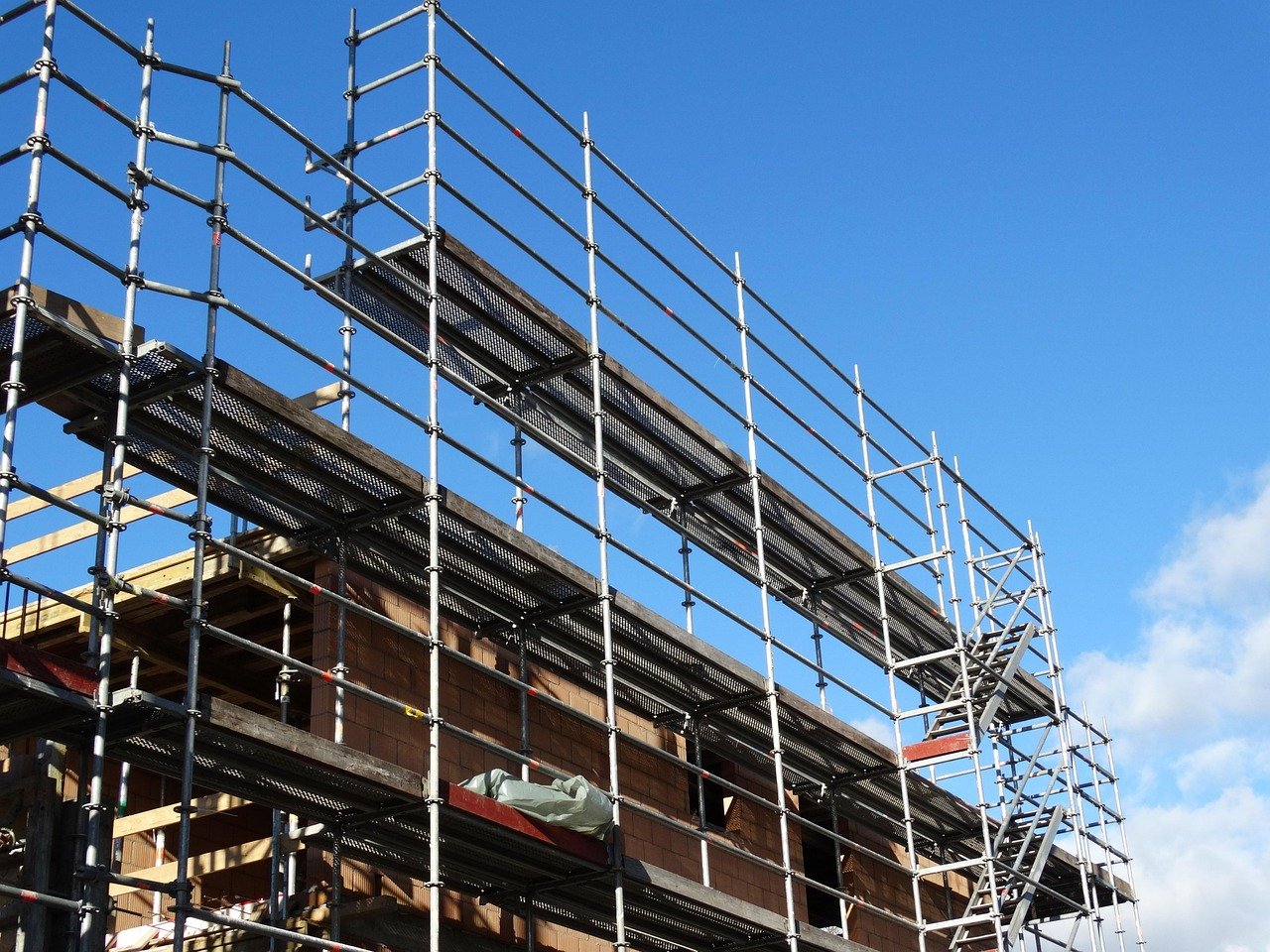
Rendering a wall sounds straightforward, but scaffolding for rendering demands unbroken coverage across the entire elevation — from ground to eaves, corner to corner. A single platform at window height will not cut it; a renderer needs to move between heights, apply consistent coats, and return for finishing passes without altering their setup.
Why Scaffolding for Rendering Means Full Elevation Access
Render is applied in layers, and each layer must be consistent across the entire face of the wall. Working from a ladder or a single-lift platform makes that impossible — reach changes, angles change, and you end up with visible joints and uneven texture once the render dries.
Most renderers will not start a job unless a proper scaffold is already in place. This is not simply professional preference; it is a safety requirement under the Working at Height Regulations 2005. Any sustained work at height — and scaffolding for rendering certainly qualifies — must be carried out from a safe working platform with edge protection.
The practical result is that render jobs almost always need a full-facade scaffold, close-boarded at multiple heights. On a standard semi-detached or terraced house, that typically means two or three lifts depending on storey height.
Why the Scaffold Stays Up Longer on Render Jobs
This is the part that catches many homeowners out. Rendering scaffolding cost is not just about the erection charge — it is also about how long the scaffold sits on your property, because render work takes longer than most people expect.
Multiple coats
Render is typically applied in two or three passes:
- Scratch coat — the base coat, keyed while still wet
- Top coat or finish coat
- Some systems include a primer or coloured render topcoat applied once the base has cured
Each coat must dry or cure before the next can go on. Depending on the product and ambient temperature, that means waiting 24–48 hours between coats — sometimes considerably longer in cold weather.
Curing and drying time
Once the final coat is on, the render needs time to cure properly before any scaffold is touched. If boards or poles knock fresh render during dismantling, you get marks that are very difficult to repair invisibly. Most renderers ask for at least two to three days after the final coat before the scaffold can be stripped — and some specify longer for certain products.
Weather delays
Render should not be applied in frost, heavy rain, or direct strong sunlight. In a typical UK autumn or winter, good working windows can be short and unpredictable. A job that might take five days in settled weather can stretch to two or three weeks if conditions are poor.
All of this means your scaffold hire for a rendering job is typically longer than for a painting or gutter repair. Plan for two to four weeks minimum on a standard house, and be prepared for it to run further if conditions intervene.
What Configuration Does a Render Job Need?
Number of lifts and boarding
For a two-storey house, you generally need two lifts — one at first-floor window height and one at eaves level. Three-storey properties need three lifts. Each lift should be fully close-boarded because renderers use tools and materials that would fall through spaced boards, and a continuous walking surface is essential when carrying awkward equipment up and down.
On wider properties, the scaffold may need internal standards at regular intervals rather than running as a single wide bay. Your scaffolding contractor will assess this during their survey — most scaffolding for render jobs is bespoke to the elevation rather than a standard off-the-shelf configuration.
Brickguard and debris netting
Render splashes. It is unavoidable. If the scaffold sits above a path, a neighbour's garden, or parked cars, brickguard sheeting on the scaffold face is essential. This is sometimes called debris netting, though brickguard is heavier and does a better job of catching wet render before it reaches the ground.
If the job involves removing existing render before applying new — common on pebbledash jobs — heavy-duty sheeting becomes even more important. Chipped render can travel a surprising distance and cause damage or injury to anyone or anything below.
Working width
Renderers typically use floats and featheredges spanning 900mm to 1,200mm wide. The platform needs to be wide enough to work comfortably and store materials — a minimum of two boards wide (roughly 600mm), ideally three. Confirm the platform width with your scaffolding contractor before the scaffold goes up, not after.
Rendering Scaffolding Cost
Rendering scaffolding cost varies considerably depending on property size, how many elevations need covering, and how long the scaffold stays up. The table below gives a guide based on typical hire durations that already account for curing time and likely weather delays.
| Property type | Elevations rendered | Typical hire duration | Approximate cost range |
|---|---|---|---|
| Terrace (2 storey) | Front only | 2–3 weeks | £400–£750 |
| Semi-detached (2 storey) | Front and side | 2–4 weeks | £700–£1,200 |
| Detached (2 storey) | Full perimeter | 3–5 weeks | £1,200–£2,500 |
| Three-storey house | Two elevations | 4–6 weeks | £1,400–£2,800 |
| Commercial or larger build | Multiple elevations | 6+ weeks | Price on application |
These ranges assume standard access conditions. A simple single-elevation job on a small terrace may come in below the lower end; a complex job on a tall detached property, or one requiring extensive weather protection, could exceed the upper end. To get a figure for your specific property, you can estimate your scaffolding cost using the free ScaffSource calculator — it takes just a few minutes based on your property details.
Scaffolding for Pebbledash
Scaffolding for pebbledash removal and replacement is among the most demanding rendering jobs, and the scaffold requirements are more intensive than for a straightforward smooth render.
The removal stage involves hacking off existing pebbledash with chisels and mechanical tools, creating significant debris, dust, and noise. The scaffold needs to be in place before any removal begins, and brickguard sheeting should cover the full face of the scaffold from top to bottom.
Some scaffolders add a catch fan — a projecting platform at low level — to capture falling material and protect pedestrians below. If your property sits on a street frontage or close to a public pavement, your scaffolder or renderer will advise whether one is required before work starts.
Once the old render is cleared, the wall typically needs repair and preparation before the new system goes on. This can add several days to the overall programme. Scaffolding for pebbledash jobs therefore tends to sit at the upper end of hire duration estimates — four to six weeks for a typical semi-detached is common, and sometimes longer depending on the extent of the underlying repairs.
Coordinating Scaffold and Renderer
Getting the timing right between your scaffolding contractor and your renderer is one of the more practical challenges of a render job. These steps make it easier:
- Book both the scaffolder and the renderer at the same time, and confirm the scaffold erection date suits the renderer's start date.
- Make sure the scaffold is erected and signed off before the renderer arrives. A renderer turning up to find no scaffold will simply leave and reschedule — potentially adding weeks to your programme.
- Agree the scaffold strip date with the renderer, not just with the scaffolding contractor. The renderer should confirm when they have finished and that the render has cured sufficiently for the scaffold to come down safely.
- If the job runs into poor weather, alert the scaffolding contractor early. Extending a hire is straightforward with enough notice; arriving at an agreed strip date unprepared is not.
For more pricing guides and practical advice on managing scaffold hire, visit the ScaffSource blog.
Getting the Right Quote
When collecting quotes for rendering scaffolding, make sure each contractor is pricing the same scope. Quotes that differ significantly often reflect different assumptions about what is included, not genuine differences in price. Key things to specify up front:
- Which elevations need scaffolding
- Approximate height to eaves
- Whether brickguard or debris netting is required
- Whether a catch fan is needed at low level
- Expected hire duration, including curing time after the final coat
- Any access restrictions — narrow alleys, neighbouring properties, busy pavements
Quotes that omit brickguard, or that assume a very short hire period, will look cheap but may not reflect the actual cost of the job. A like-for-like comparison is worth the extra effort upfront. Before you call around, get an instant price for your job to give yourself a realistic benchmark when reviewing what you are quoted.
The Short Version
Scaffolding for rendering means a full-elevation, close-boarded scaffold — not spot access or a single lift. The scaffold typically stays up longer than for other jobs because of multiple coats, curing time, and unpredictable weather. Plan for two to four weeks on a standard house, more for pebbledash removal or larger properties. Make sure brickguard sheeting is included in your quote, and coordinate the scaffold erection date directly with your renderer before either contractor confirms the booking.