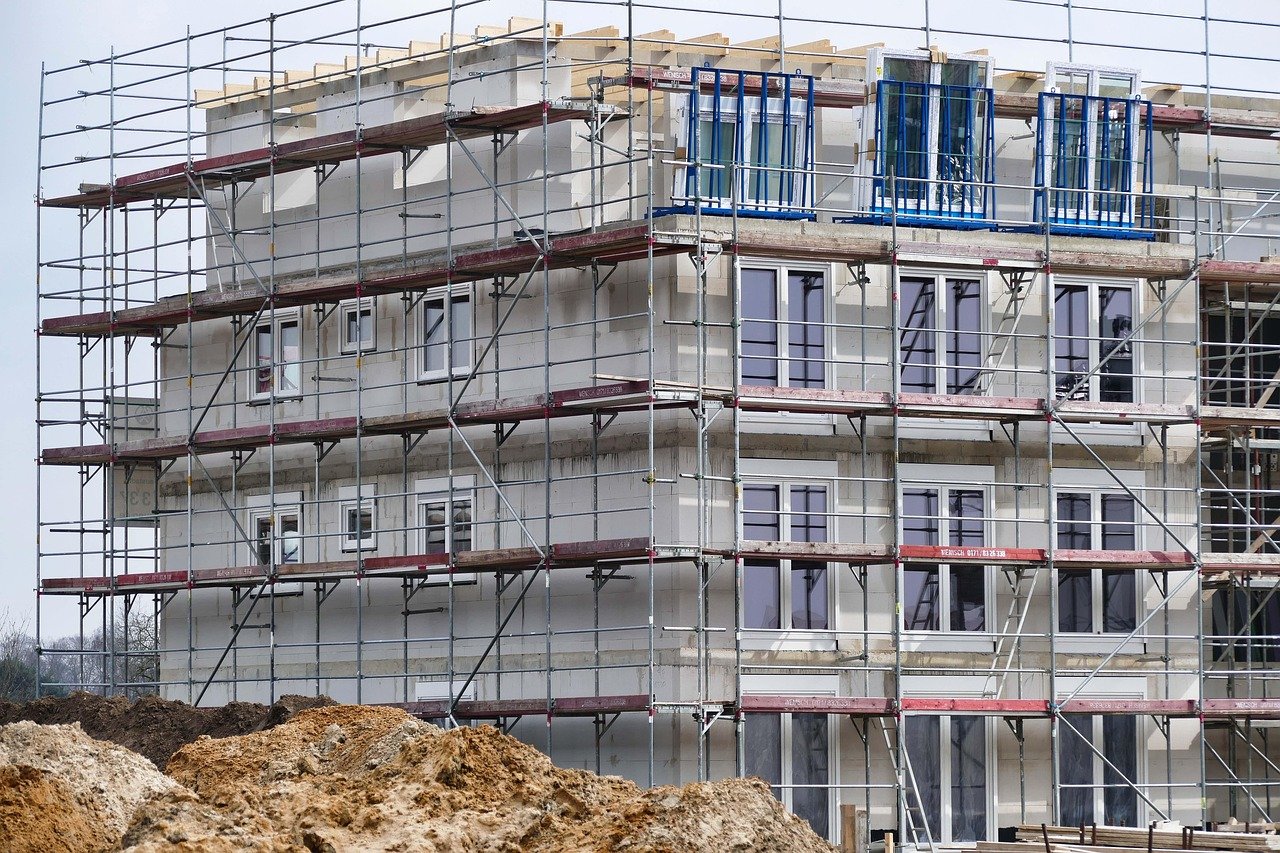
Why Most Roofers Won't Start Without Scaffolding
A full roof replacement in the UK almost always needs scaffolding — typically around the relevant elevations, for three to six weeks. If you've been searching for roofing scaffolding near me, what your property needs depends mainly on your roof's shape and the scope of the work.
A roofer stripping and relaying hundreds of tiles, replacing battens, and working along ridge lines needs a stable, continuous platform. Both hands must be free and materials need to be within reach — a job spanning several days of active work simply cannot be done safely from a ladder.
Under the Working at Height Regulations 2005, employers and self-employed contractors have a legal duty to plan work at height properly and use suitable equipment. For any full re-roof, that requirement almost always points to a proper scaffold. Your roofer will typically arrange it and include it in the quote, or specify what they need so you can hire independently. Either way, the scaffold goes up before any tiles come off.
Gabled vs Hipped Roofs: How Shape Changes the Scaffold
The two most common roof shapes in UK residential properties have quite different access requirements.
Gabled roofs
A gabled roof has two sloping sides that meet at a ridge, with triangular vertical ends — the gables. Scaffolding for a gabled re-roof typically runs along the front and rear elevations, with shorter returns at the gable ends. If the gables themselves need attention — repointing, rendering, or replacing verge tiles — scaffold bays will extend up and around those ends too.
Terraced and semi-detached houses usually have gabled roofs. For a mid-terrace, only the front and rear elevations need coverage. For a semi-detached, the exposed gable side normally needs its own run of scaffold as well.
Hipped roofs
A hipped roof slopes on all four sides with no vertical gable ends. These are common on 1930s and post-war detached and semi-detached properties. Because every face slopes, scaffolding must run on all four elevations — a full wraparound system. This costs more and takes longer to erect than a front-and-rear setup, but there is no alternative: every slope needs safe access for a full re-roof.
If you have a detached house with a hipped roof, expect your scaffolding contractor to quote for a full perimeter scaffold rather than two runs.
Typical Hire Periods for Re-Roof Scaffolding
Most residential re-roofs run for three to six weeks from scaffold erection to removal. Bad weather, material delays, or discovering hidden damage — rotten timbers, failed underlay, crumbling chimney stacks — can all extend the hire period. Building in a buffer of a few extra days is sensible, and the table below gives typical timeframes by property type.
| Property type | Roof shape | Typical scaffold hire |
|---|---|---|
| Mid-terrace, 2-bed | Gabled | 3–4 weeks |
| Semi-detached, 3-bed | Gabled or hipped | 3–5 weeks |
| Detached, 3–4-bed | Hipped | 4–6 weeks |
| Detached, 4+ bed | Complex or multiple pitches | 6–8 weeks |
These figures include a day or two for erection and a day for dismantling at the end. The actual roofing work sits in the middle. Ask your scaffolder about their policy on extended hire before signing — additional weeks are usually charged at a day rate, and knowing this in advance avoids surprises.
What's Included in a Roofing Scaffold?
New roof scaffolding for a standard UK house typically includes:
- Scaffold tubes and fittings, or system scaffold such as Kwikstage or Layher
- Scaffold boards forming the working platform at eaves level
- Toe boards along the platform edge to prevent tools and materials falling
- Debris netting or scaffold sheeting to protect your garden and neighbouring properties
- Loading bays — wider platform sections where pallets of new tiles can be safely set down
Rubbish chutes for stripping old tiles and brick guards are sometimes charged as extras. If your roofer plans to drop old tiles into a skip directly below the scaffold, confirm with the scaffolder that the loading bay is rated for the weight before work starts.
Finding Roofing Scaffolding Near Me
Searching for roofing scaffolding near me returns local firms, national booking platforms, and roofers who subcontract the scaffold work. Before booking anyone, check the following:
- NASC membership — the National Access & Scaffolding Confederation sets the industry standard. Members must comply with TG20 guidance and carry adequate insurance.
- Public liability insurance — a minimum of £5 million is standard for domestic jobs; larger or more complex sites may require more.
- Advance booking — reputable local scaffolders get booked up quickly, especially for summer work. Contact them three to four weeks before your roofer's planned start date.
- Neighbour access and licencing — if the scaffold overhangs a public pavement or sits on a shared boundary, a licence from your local council is needed. Clarify who handles this before signing anything.
If your roofer is arranging the scaffold on your behalf, ask them to confirm which company they use and that NASC membership or equivalent is in place. A good roofer will have an established relationship with a local scaffolder they trust.
What Drives the Cost of Re-Roof Scaffolding?
Prices vary considerably. The main factors are:
- Roof perimeter — a larger house needs more scaffold runs and more materials
- Ridge height — a taller property requires additional lifts, increasing both tube count and erection time
- Roof shape — a full wraparound for a hipped roof costs more than front-and-rear runs for a gabled one
- Urban access constraints — narrow streets, limited parking, or traffic management requirements add cost in city centres
- Hire duration — most quotes cover a standard period of four weeks; extra time is charged separately
Costs also vary by region: London and the South East generally run higher than the North, Midlands, or Scotland. To estimate your scaffolding cost based on your property and location, the free ScaffSource calculator factors in roof perimeter, property type, and hire length.
Scaffold Included in the Quote — or Arranged Separately?
Some roofers include scaffold in their overall price; others ask you to arrange it independently. Neither approach is wrong, but knowing the difference helps.
When the roofer includes scaffold:
- One point of contact and one invoice to manage
- The roofer takes responsibility for scheduling the scaffold around their own start date
- You cannot easily shop around for a better scaffold price
When you arrange scaffold independently:
- You can get multiple quotes and compare them
- You have direct control over hire start and end dates
- Particularly useful if your roofer is a sole trader who does not usually handle this side
Whichever route you take, make sure the scaffolding contractor provides a handover certificate before your roofer steps onto the platform. This confirms the scaffold has been inspected and is safe for use. Under the Working at Height Regulations 2005, this inspection is a legal requirement, not a formality.
Do You Need Scaffolding for a Partial Re-Roof?
Not every job is a full strip and re-lay. If only a single slope needs replacing — one side of a semi-detached roof damaged in a storm, for instance — the scaffold can be confined to that elevation. This is typically cheaper and faster to erect than a full setup.
However, if the work crosses to the other slope or involves the ridge along its full length, the scaffold still needs to follow. Partial scaffolding for roof replacement only makes sense when the work genuinely stays on one face. Your roofer should confirm what access they need before the scaffold is ordered.
Before Work Starts: What to Confirm
Confirm these points before your roofer sets foot on the platform:
- A handover certificate issued before the roofer accesses the scaffold
- Hire period agreed in writing, with a clear day rate for any extensions
- Neighbour notification done, and any required council pavement licences in place
- Loading bay capacity confirmed if your roofer is lifting palletised tiles
- Debris netting included to protect your garden and adjacent properties
You'll find more guides on planning and costs for scaffolding projects on the ScaffSource blog.
Before accepting any quotes, you can see what your project should cost using the free ScaffSource calculator — it takes your roof size, property type, and location into account.
The Short Version
A full roof replacement almost always needs scaffolding, typically for three to six weeks. Gabled roofs need front-and-rear runs with possible gable-end returns; hipped roofs need a full perimeter wraparound. The scaffold must go up before any tiles come off, and a handover certificate is required before your roofer starts working at height.
Costs vary by roof shape, property size, height, and region. Contact your local scaffolding company early — the reliable ones fill their diaries quickly, especially in spring and summer.