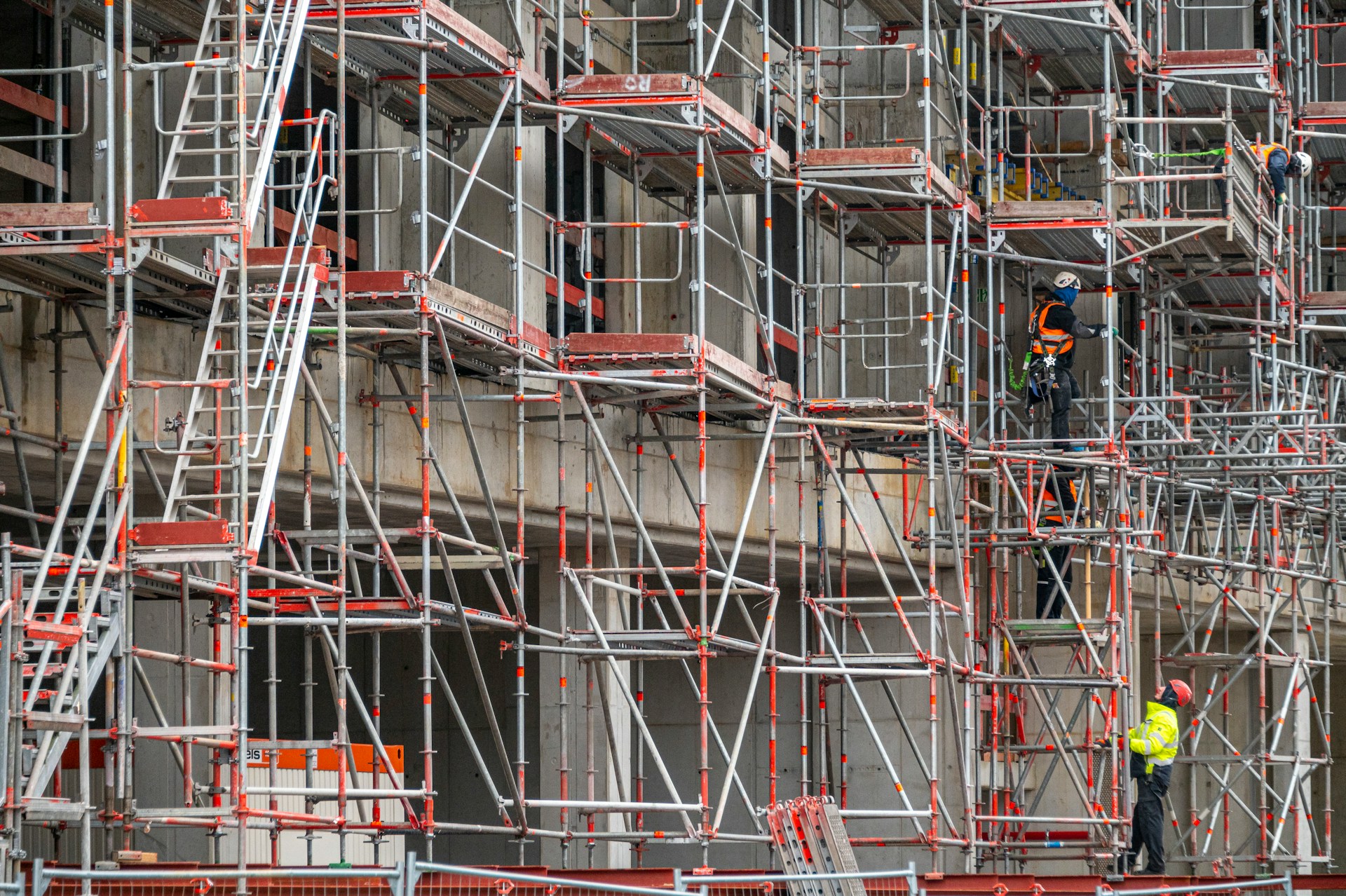
A stair scaffold gives safe access to high-level interior spaces — most commonly stairwells — where ladders are unstable and conventional tower scaffolds simply won't fit.
If you've got a stairwell that needs decorating from ceiling height, a new glazed lantern above the staircase, or repairs to plasterwork running up three storeys of a Victorian townhouse, this is the solution your contractor will reach for. Understanding what staircase scaffolding involves — and when you actually need it — helps you plan the job properly and avoid surprises when the quotes arrive.
What Is a Stair Scaffold?
A stair scaffold — sometimes called a stairwell scaffold or staircase scaffolding — is a temporary access structure built inside or around a staircase to let workers reach height safely. Unlike external scaffolding, which you've probably seen cladding the outside of a house during roof or fascia work, a stair scaffold is designed for confined interior spaces.
The structure is typically made from lightweight aluminium frames and boards, fitted to the footprint of a domestic stairwell without damaging walls, banisters, or flooring. Most domestic installations are erected by a specialist scaffolder rather than a hire-and-self-erect tower, because the geometry of staircases — turning corners, changing levels, awkward headroom — demands a bespoke solution.
The phrase "scaffold stairs" sometimes appears when homeowners search for this kind of work, but it refers to the same thing: a purpose-built access platform for working safely inside a stairwell.
When Would You Need Staircase Scaffolding?
There are several situations where a stair scaffold becomes necessary rather than optional. A set of stepladders and a paint roller won't cut it when you're working four or five metres above a stairwell void.
Stairwell Decoration
This is the most common domestic reason. Painting or wallpapering the upper reaches of a stairwell — especially in older terraced houses, semis, or Victorian townhouses with tall ceilings — requires a proper working platform. You cannot lean a ladder against a wall that runs at an angle over an open staircase and expect it to be stable.
A stair scaffold creates a level working surface at the height needed, letting a decorator work safely without constantly rebalancing on a precarious arrangement of steps and boards wedged between walls.
Stairwell Glazing and Roof Lanterns
If you're adding a glazed ceiling, a roof lantern above a stairwell, or rooflights above an open staircase, the glaziers need to work from below as well as above. The scaffold provides the internal platform for fixing, sealing, and finishing at height.
This type of work has become more common as homeowners extend upward or convert loft spaces, creating taller stairwells that benefit from natural light coming in from above.
Plasterwork and Ceiling Repairs
Replastering a stairwell ceiling or repairing coving in a period property often requires work across a wide, high area. The sloping ceiling above a staircase is particularly tricky — it changes height as you move up the stairs, which means any working platform needs to accommodate that geometry rather than sitting flat at one fixed level.
Electrical and Lighting Work
Replacing a pendant fitting, installing a lighting chain, or running cables along a stairwell ceiling all fall into the same category. An electrician working at height in a stairwell needs a stable platform, not a balancing act on a ladder propped at an angle over a drop.
How Much Does Stair Scaffold Cost?
Costs vary considerably depending on the height of your stairwell, the number of turns — straight stairs versus an L- or U-shaped staircase — and how long the scaffold is needed. A simple two-storey straight stairwell installation costs noticeably less than scaffolding a winding stair in a four-storey townhouse.
Duration matters too. Most decorator or repair jobs need the stair scaffold for one to five days, though larger projects — full stairwell replastering or glazing work with associated making-good — can run longer. The scaffolder's time to protect your hall floor and banisters during the works also factors into the final price.
To get a realistic figure for your specific job, estimate your scaffolding cost using the ScaffSource calculator — it accounts for the key variables that affect price, rather than offering a single misleading number.
| Stairwell Type | Typical Hire Duration | Relative Cost |
|---|---|---|
| Straight two-storey stairwell | 1–3 days | Lower end of range |
| L-shaped or quarter-turn staircase | 2–5 days | Mid-range |
| U-shaped or half-turn staircase | 3–7 days | Upper-mid range |
| Multi-storey or period townhouse stairwell | 1–3 weeks | Higher end of range |
These figures are indicative. A reputable scaffolder will want to visit the property before quoting, because the physical constraints of an interior stairwell — access through the front door, protection of floors and banisters, proximity to walls — all affect how long installation takes and how the system needs to be configured.
How Stair Scaffolding Is Configured
There is no single stair scaffold design. Scaffolders adapt the system to the geometry of the stairwell. The most common configurations for domestic properties are:
- Spanning platform: A horizontal working deck built at a fixed height across the stairwell, resting on the walls or a freestanding frame. Best for straight stairwells with a consistent ceiling height.
- Stepped platform: For staircases that change direction, multiple platforms at different heights are connected, following the line of the stair to maintain a safe working height throughout.
- Independent tower within the stairwell: A freestanding aluminium tower, custom-fitted to the stairwell width, providing access at one specific level. Used where only a small area needs attention.
- Birdcage scaffold: For large or open stairwells — common in period townhouses — a birdcage arrangement gives access across the full ceiling area at one or more levels simultaneously.
Your scaffolder will assess the stairwell geometry, the access route through the property, and the nature of the work before settling on a configuration. In most domestic cases they'll also lay board or card protection to guard your hall and stair carpet during erection and use.
Planning Permission and Regulations
Internal scaffolding within your own property doesn't require planning permission or a highway licence — those are only needed for external scaffold that projects over or near the public pavement or highway.
The scaffold must still comply with the Working at Height Regulations 2005 and the relevant HSE guidance. Any contractor erecting a stair scaffold should be competent to do so — ideally a member of the NASC, or employing CISRS-certified operatives. It's entirely reasonable to ask for evidence of this before work starts, particularly in older properties where the structure may be less predictable than it looks.
If your property is listed, it's worth checking with your local conservation officer before any scaffold is fixed to walls — though most interior stair scaffolds are freestanding and don't require fixings into the building fabric at all.
What to Ask Before Hiring a Scaffolder for Stair Work
Getting the right scaffolder matters more for interior work than it does for a straightforward external setup. The confined space, proximity to your décor and flooring, and the need to maintain some access through the house during the works all require care and experience.
Before accepting a quote, ask:
- Have they erected a stair scaffold in a property similar to yours in layout and height?
- Will they protect floors, walls, and banisters during installation and while the scaffold is in use?
- What access will remain to the upper floors while the scaffold is up?
- Are their operatives CISRS-certified and does the company hold NASC membership?
- Do they carry adequate public liability insurance?
A reputable scaffolder will expect these questions and answer them without hesitation. If any feel unwelcome, treat that as useful information about the firm.
Alternatives Worth Considering
For lower-level stairwells — roughly under three metres to the highest working point — there are alternatives to a full stair scaffold that may suit the job:
- Decorator's stairwell platforms: Specialist adjustable-leg platforms designed to straddle a staircase at an angle, giving a stable surface at a fixed height. Accessible for a careful DIYer on straightforward painting work, but they won't safely reach the ceiling of a tall stairwell.
- Aluminium scaffold towers: A small tower can sometimes be positioned at the base of a stairwell to reach a specific area. Not practical for L- or U-shaped stairs, or for work spanning a wide area.
- Decorator's own equipment: Many professional decorators who specialise in period properties carry their own stairwell platforms as part of their kit. Worth asking whether your decorator includes this in their price before booking a separate scaffolder.
None of these fully replaces a bespoke stair scaffold for complex or high stairwells. If the ceiling is above three to four metres, or the staircase changes direction, a proper scaffold is almost always the right approach — and attempting the job with improvised equipment creates the kind of risk the Working at Height Regulations 2005 exist precisely to prevent.
Getting the Right Price Before Quotes Arrive
The simplest way to understand what your stairwell job should cost is to see what your project should cost with the ScaffSource calculator before you start calling round for quotes — it gives you a realistic range to benchmark against.
You'll find more job-specific pricing guides on the ScaffSource blog, covering everything from chimney stack scaffolding to full house erections and everything in between.
The Short Version
A stair scaffold is the right solution when you need to work safely at height inside a stairwell — for decorating, glazing, plastering, or electrical work. The configuration depends on your staircase geometry and the height involved, and costs vary based on complexity and how long the works take.
For anything above a straightforward lower-level stairwell, a specialist scaffolder is the right call. Get at least two quotes, ask the right questions about their experience with interior work, and use a calculator to set realistic expectations before anyone arrives on site.