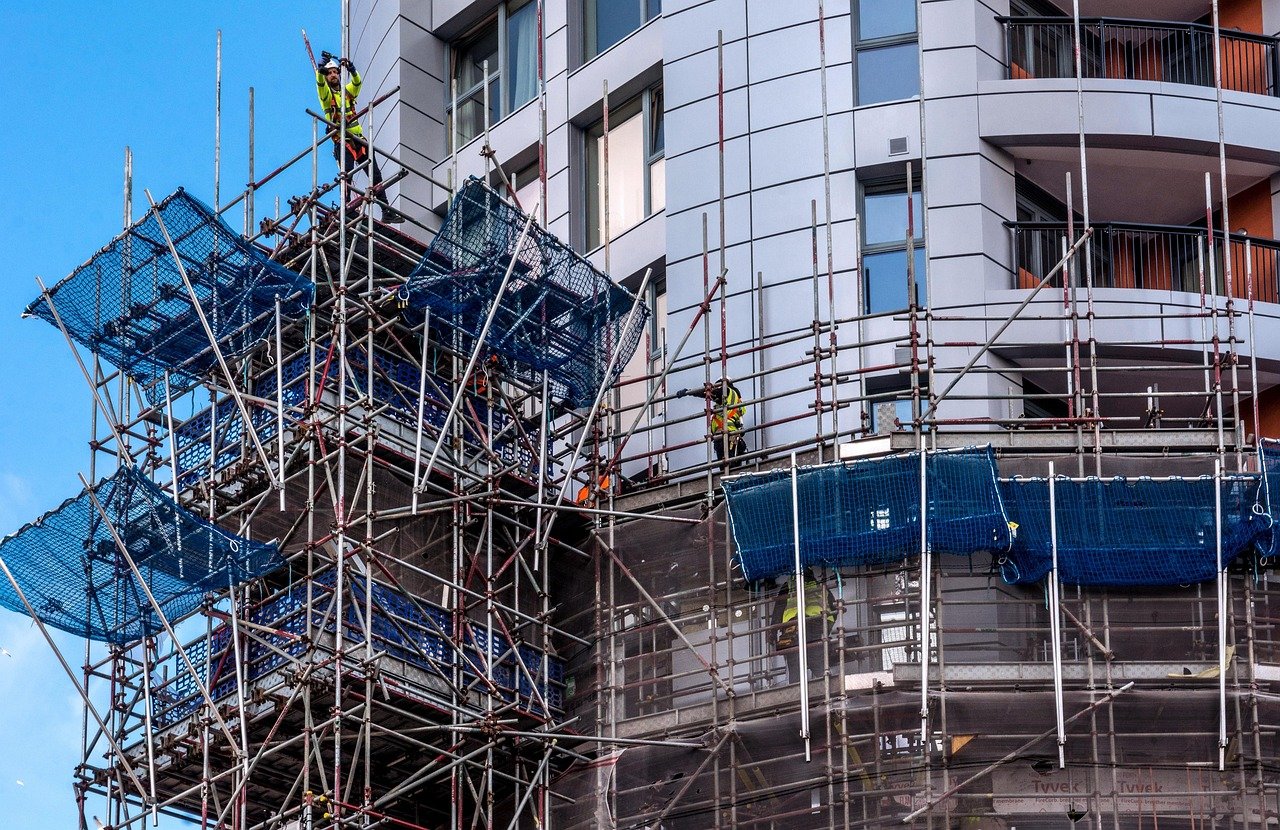
A temporary roof scaffolding system is the weatherproof structure you sometimes see draped over houses during a full re-roof — it keeps the building dry while the existing covering is stripped away and a new one goes on. If your contractor has quoted for one and you weren't expecting it, this guide explains what it is, when it's genuinely necessary, and what it adds to the overall cost.
What is a temporary roof system?
A temporary roof system — often shortened to TRS scaffold or roof cover scaffold — is a waterproof enclosure fitted above a standard scaffolding structure. Aluminium or steel lattice beams span across the scaffold tubes at or above ridge height, and heavy-duty sheeting is fixed over them to create a weatherproof shell around the entire roof. From the street it looks like a large, low-pitched tent sitting above your home.
The purpose is practical: if your roof needs to come off completely — every tile, batten, and underlay stripped back to bare rafters — you are left with an unprotected structure for days or even weeks. A period of wet weather during that window can cause serious damage to ceilings, plasterwork, and roof timbers. The temporary roof system is what stands between your exposed rafters and a fortnight of British rain.
When do you need temporary roof scaffolding?
Not every roofing job calls for a full cover. Replacing a handful of slipped tiles, patching a localised leak, or relining a valley doesn't expose enough of the roof to make a TRS scaffold necessary. It becomes the right choice when the scope of work leaves the structure genuinely open to the elements for an extended period.
The most common situations where a temporary roof system is required:
- Full re-roofs — stripping the entire roof covering and replacing it from scratch typically takes at least a week on a standard semi-detached or terrace, sometimes considerably longer.
- Major structural roof repairs — replacing rotten or damaged rafters, purlins, or a ridge beam requires removing large sections of the covering, leaving the structure exposed for the duration.
- Chimney stack rebuilds — when the stack needs to come down to or below the roof line and the surrounding area of tiles must be disturbed on a significant scale.
- Loft conversions in progress — some programmes cannot afford weather delays, and a TRS scaffold allows structural roof work to continue regardless of the forecast.
If you have been quoted for temporary roof scaffolding and the work looks minor to you, it is entirely reasonable to ask your contractor why a full cover is needed. A good roofer will explain the scope clearly and how long the structure will be open to the elements.
What does a temporary roof system look like?
From the pavement, a completed TRS scaffold can look imposing — a rectangular frame sitting above the roofline, with white or silver sheeting pulled taut across it. On a terrace or semi-detached it will usually span from gable end to gable end, covering the full roof footprint with a small overhang on each side and at the eaves.
The structure is built on top of the standard working scaffold. Once the platform levels are in place around the walls, the scaffolders erect a further set of tubes above ridge height, install the spanning beams, then fix the weatherproof sheeting. On larger jobs, internal guttering may be incorporated so that rainwater drains off the sheets rather than pooling on the working platforms below.
Access is usually through a door or lifting flap at one gable end, allowing materials and waste to move in and out. Inside, roofers work in a covered space — not comfortable exactly, but dry.
How much does temporary roof scaffolding add to the cost?
This is usually where homeowners get a surprise. A standard scaffold for a re-roof — eaves platforms with a working level at or near ridge height — is priced one way. Adding a full temporary roof system can increase the scaffolding element of the quote substantially, because of the extra materials (beams and sheeting), the additional labour to erect and dismantle it, and the weekly hire charge while it stays in place. If you want a clearer picture of what the total might look like for your property, you can estimate your scaffolding cost before speaking to contractors.
The table below gives a rough sense of what a TRS scaffold can add over standard eaves-and-ridge scaffolding on similar properties. These are indicative ranges — the actual figure depends on roof pitch, span, your location in the UK, and the contractor you use.
| Property type | Standard scaffold | With TRS scaffold |
|---|---|---|
| Terrace (2-bed) | £600–£900 | £1,400–£2,200 |
| Semi-detached (3-bed) | £800–£1,200 | £1,800–£2,800 |
| Detached (4-bed) | £1,000–£1,600 | £2,400–£4,000 |
| Larger detached or complex roof | £1,500–£2,500+ | £3,500–£6,000+ |
Several factors push the cost in either direction:
- Roof pitch — a steeper pitch requires a taller structure with more material and more sheeting.
- Span — a wider property needs longer beams and more of them, which raises both material and labour costs.
- Hire duration — most scaffolders quote for an initial hire period, commonly four to eight weeks, and charge a weekly rate beyond that. If the job overruns, costs rise.
- Sheeting grade — heavier, more wind-resistant sheeting is sometimes specified for exposed sites or winter work.
- Location — scaffold rates in London and the South East are generally higher than in the North, Midlands, or Wales.
Is it always the roofer's call?
The roofer leading the project will usually specify whether temporary roof scaffolding is needed, based on the scope of work and the planned programme. On larger or more complex jobs, the scaffold contractor may also be involved in designing the TRS structure — particularly where it needs to span an unusual distance or carry additional load.
HSE guidance and the Working at Height Regulations 2005 require that work at height is properly planned and that weather risk is considered as part of that planning. On a full re-roof, leaving the structure open to rain is both a health and safety concern — wet surfaces and timbers increase the risk of slips and falls — and a practical one. A temporary roof system is one of the standard industry responses to that risk.
If you are comparing quotes and only one includes a TRS scaffold, ask the others how they plan to manage the period when the roof is open. The presence of a TRS in a quote is not automatically a sign of overcharging — it may mean the others are cutting a corner.
How long will you need it in place?
Hire periods for temporary roof scaffolding are agreed as part of the overall scaffold contract. A typical initial hire period might be four to eight weeks — usually enough for a straightforward full re-roof on a standard house, with some buffer for minor delays.
Problems arise when the programme slips because of unexpected structural repairs to timbers, material lead times, or consecutive days lost to high wind. Every week beyond the agreed period will incur a further charge, typically at a weekly rate set out in the original quote. It is worth clarifying that rate before work begins so the figure is not a surprise if things take longer than expected.
On the other hand, if the job finishes ahead of schedule, some scaffold contractors will adjust the charge accordingly — though not all will, particularly if the sheeting and beams have already been committed to that slot in the yard.
What to check before work starts
A few practical points worth confirming before temporary roof scaffolding is erected on your property:
- Who is responsible for the scaffold design? On larger TRS structures, a scaffold design drawing — produced to TG20 guidance or a bespoke structural engineer's calculation — may be required. Confirm this is in place before work starts.
- What does the hire period include? Does the quoted price cover dismantling and collection, or is that charged separately? What is the weekly rate if the programme overruns?
- Is the scaffold company NASC-registered? The National Access & Scaffolding Confederation maintains standards for its members. It is a straightforward question to ask when getting quotes.
- What are the wind restrictions? Sheeted scaffolds catch significant wind load. Ask whether there are weather conditions that restrict access under the structure, and how the contractor monitors this on site.
- Is a licence needed? If the scaffold occupies any part of the pavement or public highway, a licence from your local council will be required. Clarify who arranges this and whether the cost is included in the quote.
You can find more guides on scaffolding costs for specific jobs on the ScaffSource blog, covering everything from chimney work to loft conversions. Before approaching contractors, it also helps to see what your project should cost so you have a realistic benchmark when comparing quotes.
The short version
A temporary roof scaffolding system is a legitimate and often essential part of a full re-roof or major structural roof repair. It keeps the building weatherproof while the existing covering is off — reducing the risk of water damage and making the working environment safer for the team on site.
It adds to the scaffolding cost, sometimes doubling it or more, because of the extra materials, labour, and ongoing hire charge. The key questions to ask are why it is needed for your specific job, what the hire period covers, and what the weekly charge is if the programme overruns.
Get at least three quotes and make sure each one specifies whether temporary roof scaffolding is included. If one quote omits it where others include it, that is worth querying rather than assuming the cheaper option represents equivalent work.